
Four years after the specification, Auracast sits inside a great many devices that were sold long ago. What matters now is enabling it in the menu. That began in 2025.
The short answer
It is not the chip, and it never was. The radio hardware has been fitted since late 2021 and the specification has been finished since mid 2022.
What was missing was the device makers switching it on. That is exactly what is happening now: on Android since September 2025, broadly across Samsung since spring 2026, and in parallel across a growing number of hearing aids and earbuds.
Something is still missing too. One large smartphone platform is not on board, and two of the big hearing aid groups have announced but not yet shipped. Both are solvable for a venue, and solvable today.
Two pictures from this year
In January 2026 Frankfurt Airport put the world’s first Auracast operation at an airport into service, initially at two gates in Terminal 1. The transmitting units sit inside the existing announcement stations, with no rewiring.
In July 2026 Munich Airport followed with six gates across two terminals. On compatible devices the announcements fade in over whatever music is playing and fade out again afterwards.
Six months apart, three times the scale. That is the pace this technology is moving at.
The hardware came first
Qualcomm’s own product brief calls the Snapdragon 8 Gen 1, in November 2021, the first Snapdragon to support broadcast audio. The Public Broadcast Profile that Auracast builds on was ratified eight months later. Android 13 brought Bluetooth LE Audio into the operating system in August 2022.
After that, very little happened that an ordinary user could have noticed.
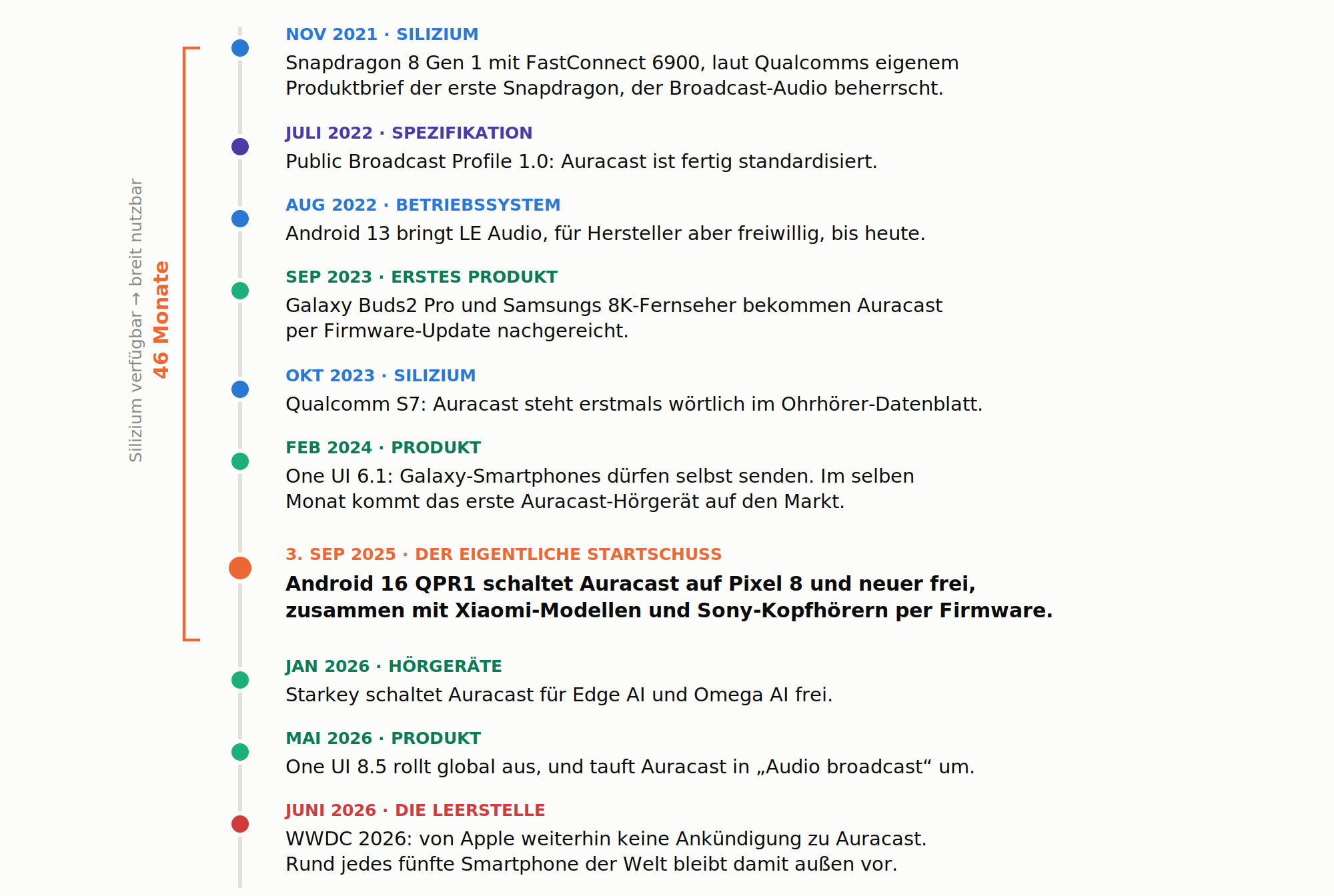
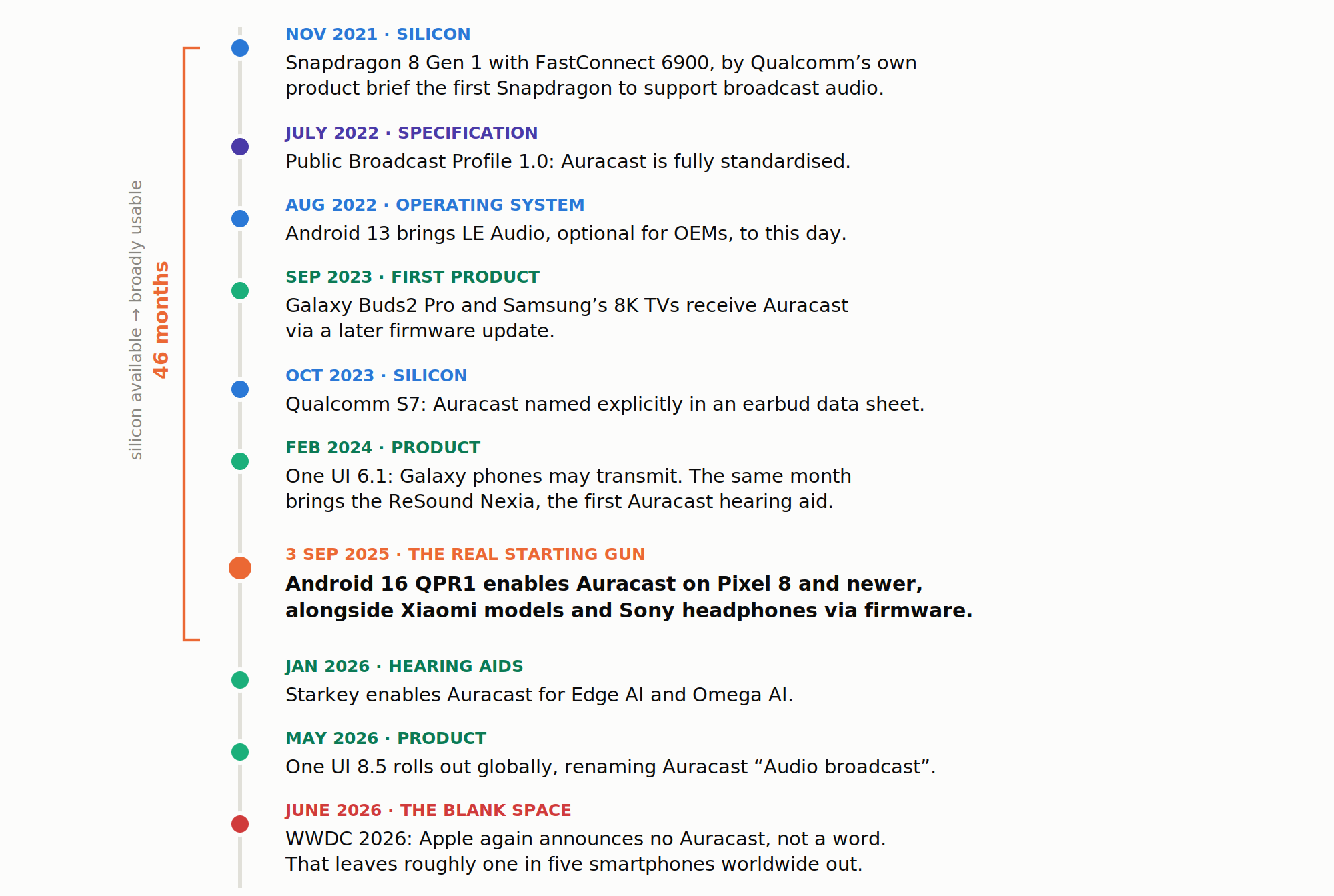
46 months from chip to user. The radio hardware was available at the end of 2021 and the specification by mid 2022. What held things up was not the chip but enabling the function in the menu.
Qualcomm Snapdragon 8 Gen 1 Product Brief (30 November 2021); Bluetooth SIG, Public Broadcast Profile 1.0 (5 July 2022); Samsung Newsroom (29 August 2023); Android Authority (20 February 2024); Google blog (3 September 2025); Samsung support (May 2026).
The first consumer product with working Auracast arrived in September 2023, when Samsung enabled it by firmware update for the Galaxy Buds2 Pro and its premium televisions. The broad rollout followed on 3 September 2025, when Google enabled Auracast with Android 16 QPR1 on Pixel 8 and newer, alongside several Xiaomi models and Sony headphones by firmware.
From the first Auracast capable smartphone chip to broad availability took 46 months. That run-up has now been worked through, and it does not happen a second time.
Three levels worth keeping apart
“Supports Auracast” can mean three quite different things. If you are procuring devices, keep the levels separate.
- The chip can do it. The radio capability has been specified since Bluetooth 5.2, but as an optional feature. A data sheet that says “Bluetooth 5.3” does not guarantee it.
- Firmware and software enable it. On modern radio chips the Bluetooth version is partly a property of the firmware rather than the hardware.
- The device maker switches it on in the menu. This is where the real delay sat.
Documented cases show how wide that gap can be.
| Case | Hardware since | In the menu since | Gap |
|---|---|---|---|
| Google Pixel 8 and 8 Pro | Oct 2023 | Sep 2025 | 23 months |
| Google Pixel Buds Pro 2 | Sep 2024 | Sep 2025 | 12 months |
| Samsung Galaxy S23, transmit function | Feb 2023 | Feb 2024 | 12 months |
The Pixel Buds Pro 2 are the best documented case. They could do Auracast out of the box, it simply was not advertised, because at the time no Pixel phone offered the other end of the link.
A note for procurement. The dividing line does not follow the device generation. The Pixel 8a and 9a lack the necessary radio hardware although they carry the same main processor as the larger models, because the connectivity chip is cheaper. The same pattern shows up in televisions, where within one model range the larger sets transmit Auracast and the smaller ones do not. No end device data sheet reveals this reliably. When in doubt, ask about the specific model number.
Where Auracast already arrives
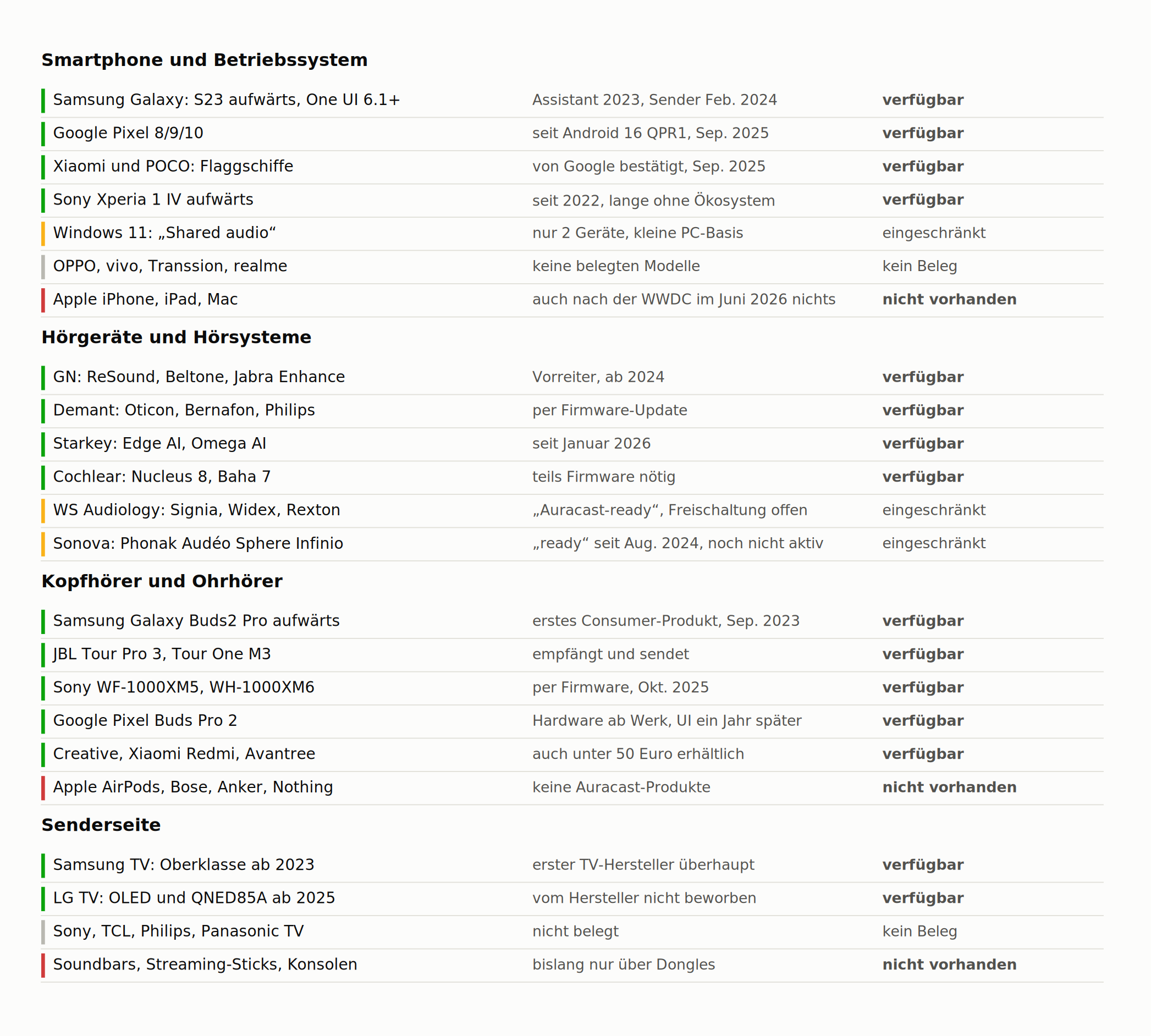
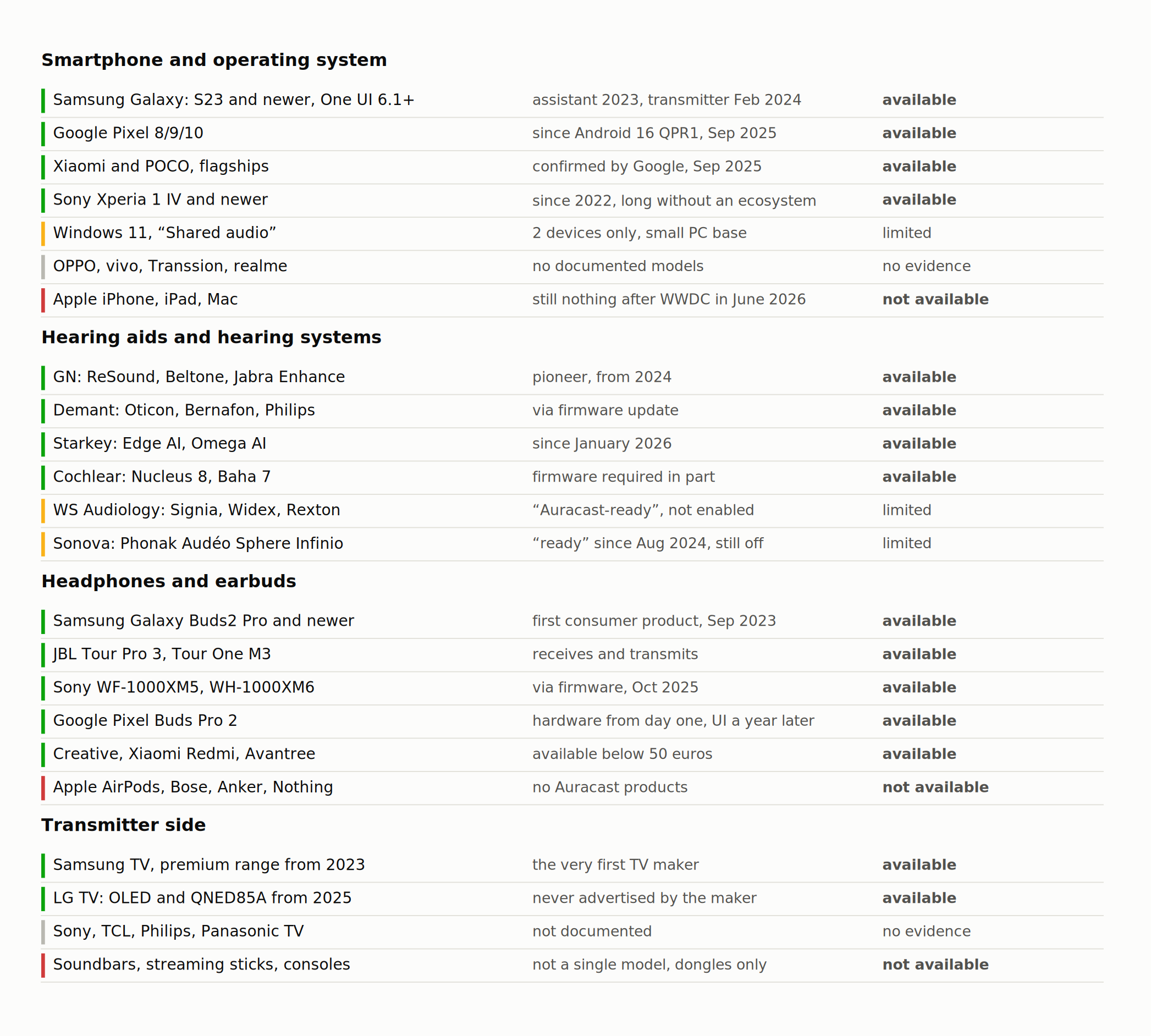
Where Auracast already arrives. As of 7 August 2026. “Limited” means the hardware and the announcement exist, but the function is not yet reachable for users, or only in part.
Compiled from manufacturer information, the Auracast product list of the Bluetooth SIG, the Google blog of 3 September 2025, Samsung support (as of 26 May 2026), Apple specifications, HearingTracker and Aurahear (as of July 2026). “No evidence” does not mean “cannot do it”, only that no reliable source could be found.
The map has four notable features.
On the receiving side the matter is settled. There are Auracast earbuds from Samsung, Sony, JBL, Google and Technics, and by now in the budget segment as well. Models below fifty euros are available. The price argument is off the table.
Four large hearing aid suppliers are shipping. GN with ReSound, Beltone and Jabra Enhance has been there since 2024, Demant with Oticon, Bernafon and Philips by firmware update, Starkey since January 2026, Cochlear for the Nucleus 8 and Baha 7. For a substantial share of hearing aid wearers, Auracast is therefore usable directly today, with no extra device.
The transmitter side is growing more slowly. Three television makers transmit Auracast; soundbars and games consoles so far do not. For a venue that hardly matters, because there a professional transmitter is connected to the existing sound system rather than a television.
Windows provides the technology but calls it something else. “Shared audio” streams to two devices at once and does not work as an open broadcast to any number of listeners. For a hall that is no substitute. For a desk it is a useful addition.
What is still missing
Honesty belongs in a stocktake, otherwise you plan badly.
As of August 2026 no Apple operating system supports Auracast, neither as transmitter nor as receiver. The AirPods Pro 3 from September 2025 still use Bluetooth 5.3 without LE Audio, and neither the accessibility announcement in May 2026 nor WWDC in June brought anything on the subject.
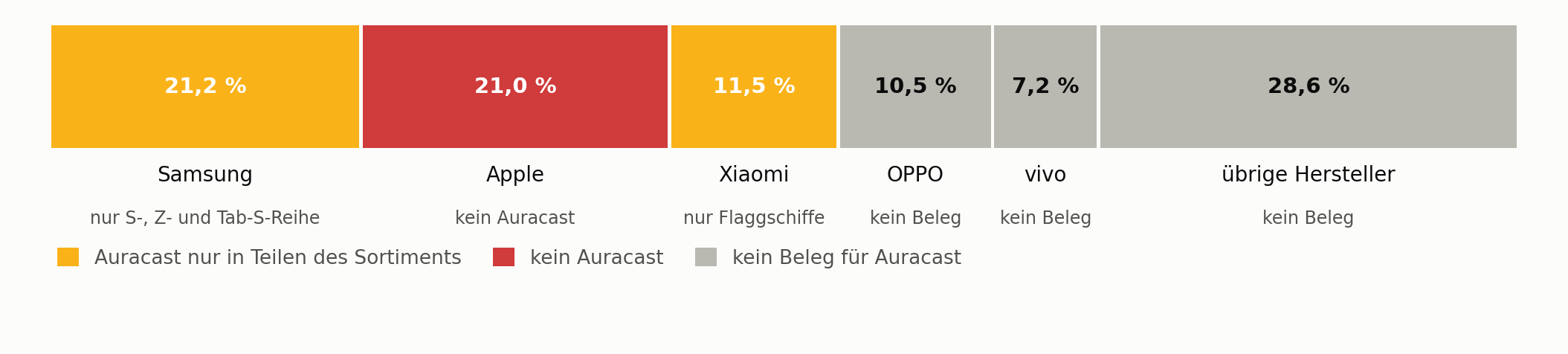
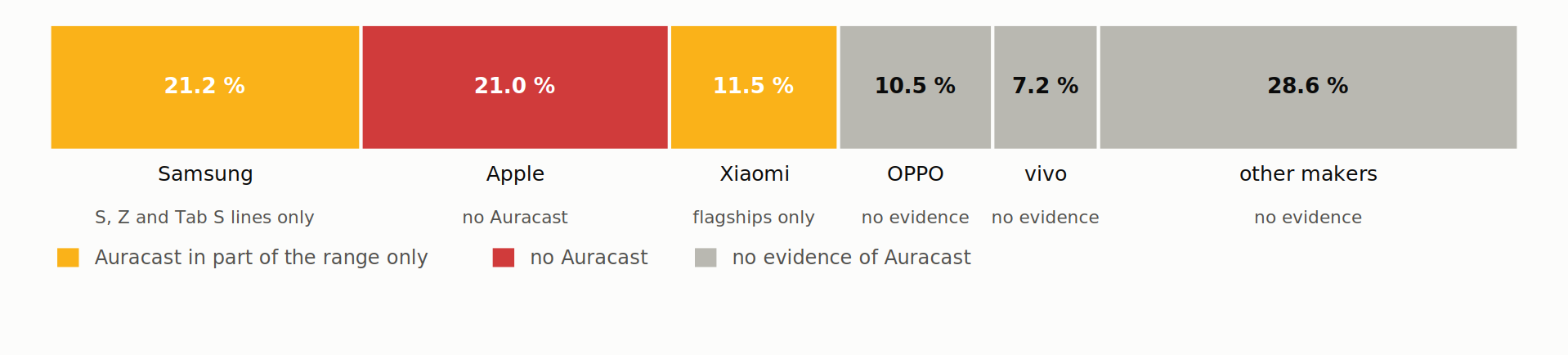
The smartphone market by Auracast support. Worldwide shipments in the first quarter of 2026, 293.8 million devices in total. The platform without Auracast accounts for 21.0 per cent of them.
Market shares: IDC Worldwide Quarterly Mobile Phone Tracker, data as of 23 June 2026. Auracast capability assigned from the documented device lists; no market researcher publishes an official statistic on this.
Apple held 21.0 per cent of worldwide smartphone shipments in the first quarter of 2026, according to IDC. So anyone building a system into a station or a theatre has to reckon with roughly one guest in five being unable to pick up the signal with their own phone.
That is a planning figure, not a knock-out criterion, and it is exactly what loan receivers are for. A dedicated device belonging to the venue works regardless of what phone anyone happens to be carrying, and with an inductive neckloop it additionally reaches hearing aids without Auracast. We set out the reasoning in Auracast, the successor to induction loops and telecoils: the standard provides reach, the receiver provides reliability. There is field evidence for this too. The Traverse Theatre in Edinburgh, reporting on its own installation in June 2026, noted that fewer audience members than expected currently have Auracast compatible hearing aids. That is the honest picture of a transition period, and it is precisely the gap a loan fleet closes.
On the hearing aid side, two of the large groups have announced their platforms as Auracast capable but have not yet released the function. The reason given includes the international standard for Auracast assistive listening systems that is still missing and is currently expected at the end of 2027. For you as an operator that simply means one thing: plan for a mixed audience for the next two years.
Why it takes time, and why it is nevertheless moving
Two effects explain the pace better than any statement of intent, and both can be calculated.
Three things have to be present at once
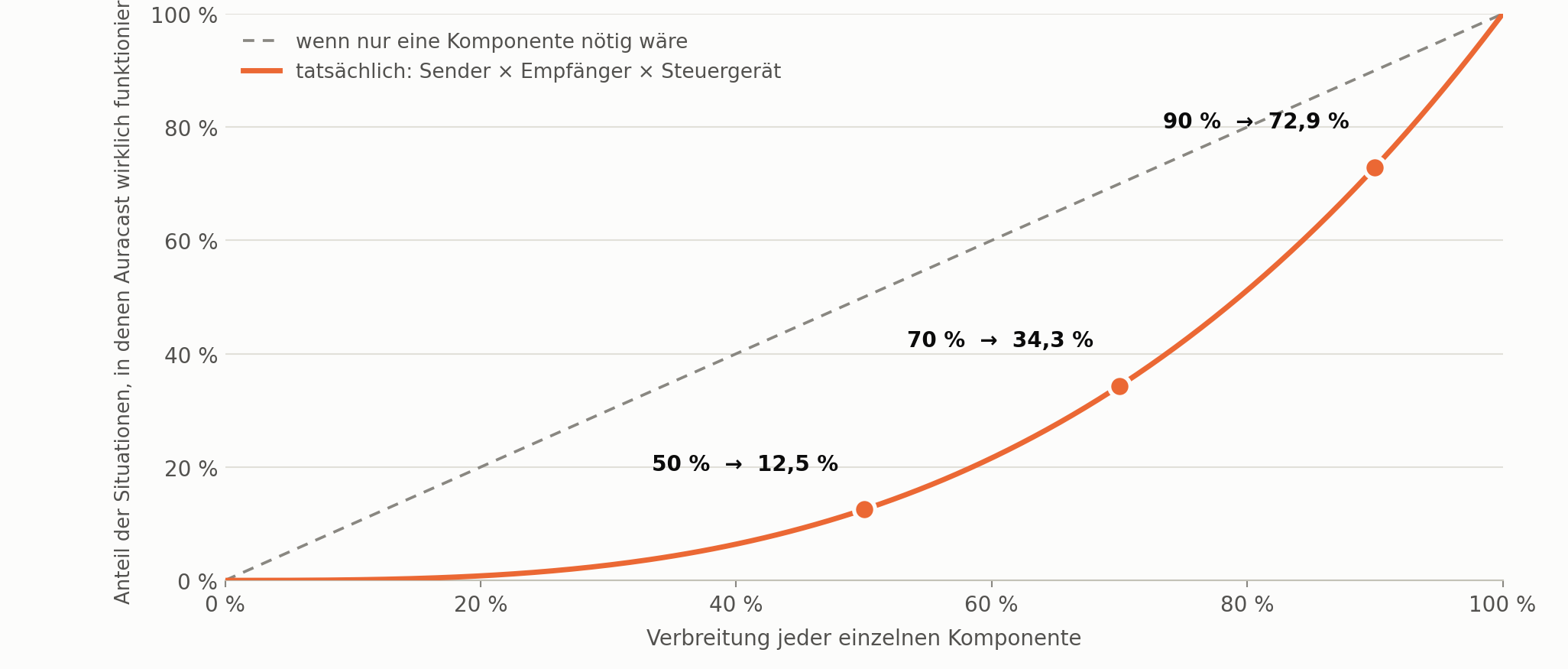
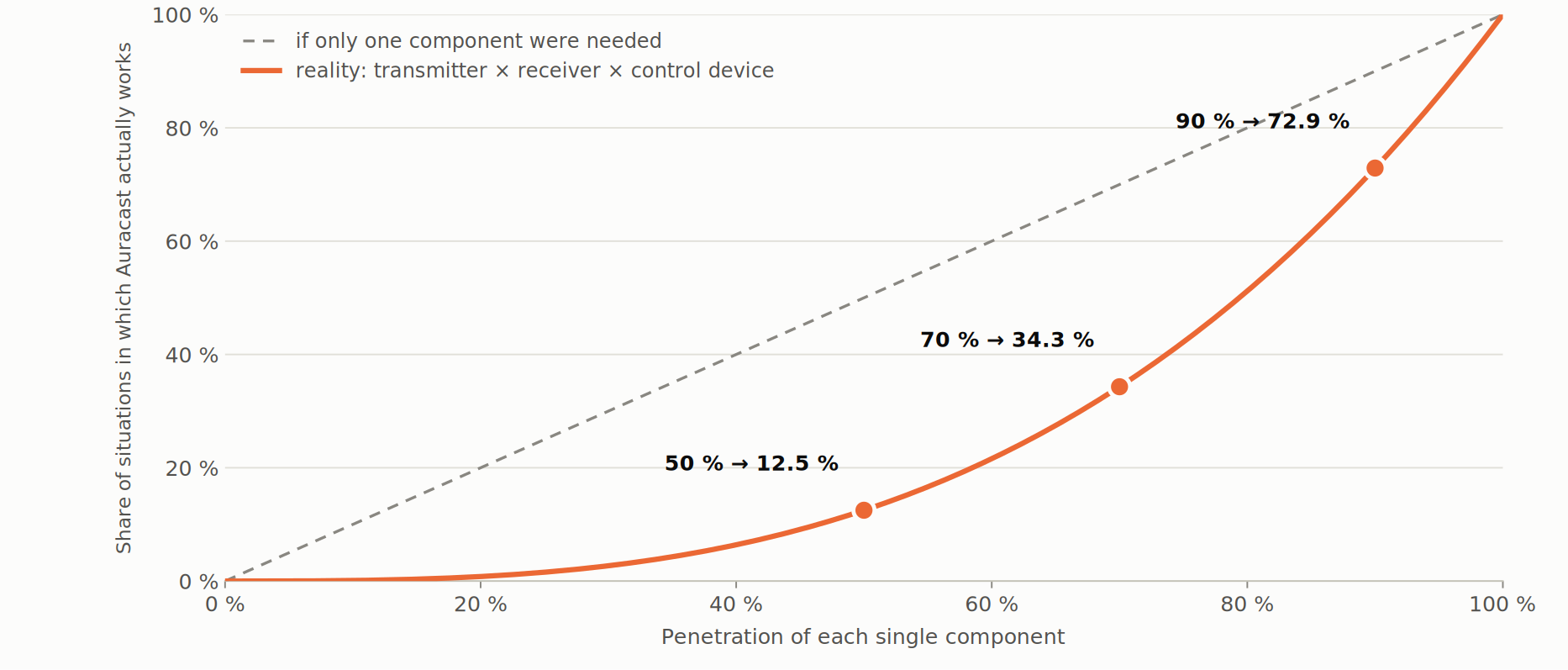
Auracast needs three things at once. A transmitter in the room, a receiver in the ear, a control device in the hand. If one is missing nothing happens, which is why the penetration rates multiply rather than add.
Own model calculation with three independent, equally widespread components. Simplified, but the order of magnitude explains the SoundGuys reader survey of December 2025.
An everyday Auracast experience needs a transmitter in the room, a receiver in the ear and usually a control device in the hand. If one of them is missing, nothing happens. So the penetration rates multiply rather than add.
At fifty per cent penetration each, it comes together in twelve to thirteen per cent of situations. At seventy per cent it is thirty four, at ninety per cent it is seventy three. The curve gets steep towards the top. Which is exactly why progress looks invisible for a long time and then suddenly fast.
The same arithmetic explains why many people have not heard of the technology. A reader survey by a headphone specialist magazine found in December 2025 that two thirds of respondents had never heard of Auracast.
For a venue the practical conclusion is pleasantly simple. Provide the transmitter and keep loan receivers on hand and you control two of the three factors yourself, without waiting for the market.
The installed base renews slowly
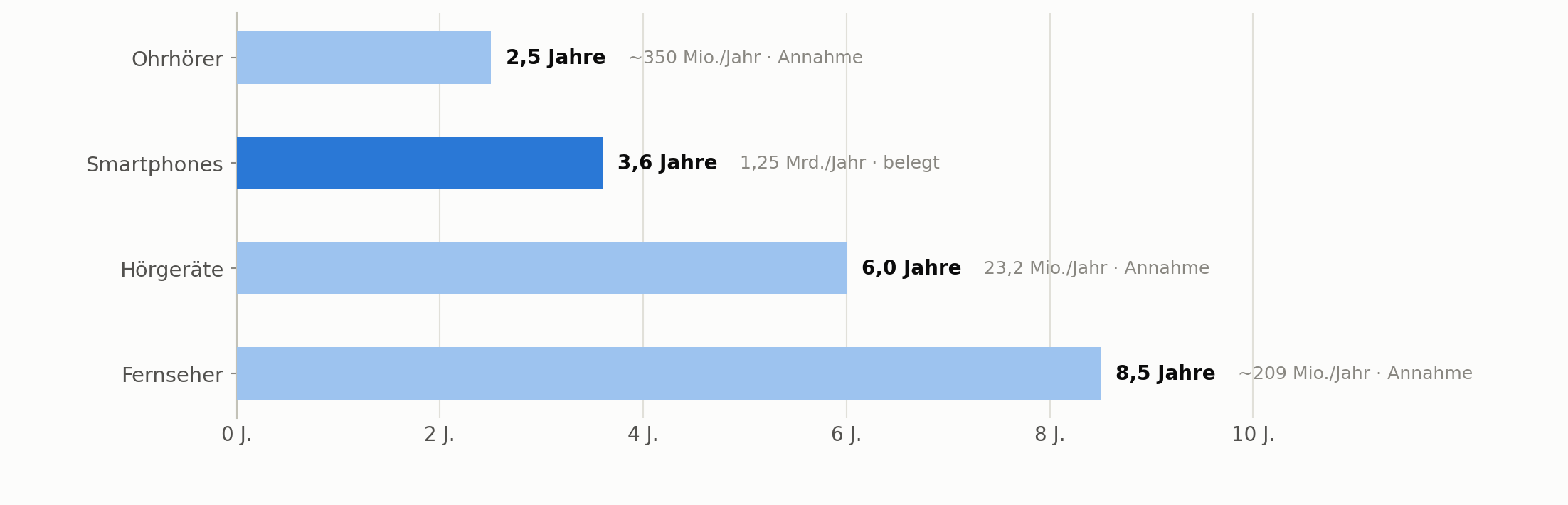
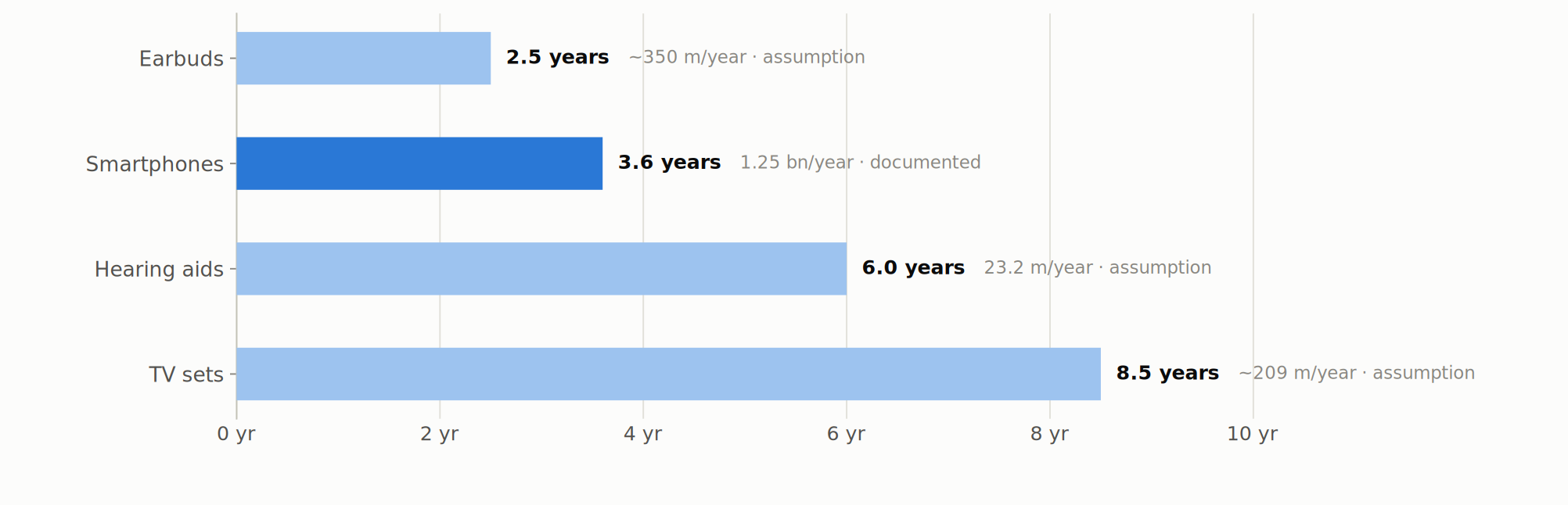
How long a device base takes to renew. How long the installed base takes to turn over completely, assuming every device sold from now on came with Auracast.
Smartphone replacement cycle: Counterpoint Research, 18 November 2025. Hearing aid volumes: EHIMA, 20 May 2026. Televisions: Omdia, 26 June 2025. Smartphones: IDC, 2 December 2025. The replacement cycles for earbuds, hearing aids and televisions are industry rules of thumb.
Even if every device sold from today onwards supported Auracast, the installed base would take years to fill up. The worldwide smartphone replacement cycle sits at 43.4 months according to Counterpoint Research. For hearing aids the industry works with five to seven years, for televisions with eight to ten.
A look back is worth having for comparison. Bluetooth 1.0 took six to seven years from specification to mass market, A2DP about five, Bluetooth LE four to six. Auracast, at a projected six to eight years, sits at the upper end of that range but not outside it. A trade publication dated the realistic mainstream moment back in 2024 to the year 2028. Judged by what has shipped since, that still looks plausible.
A word on the market forecasts
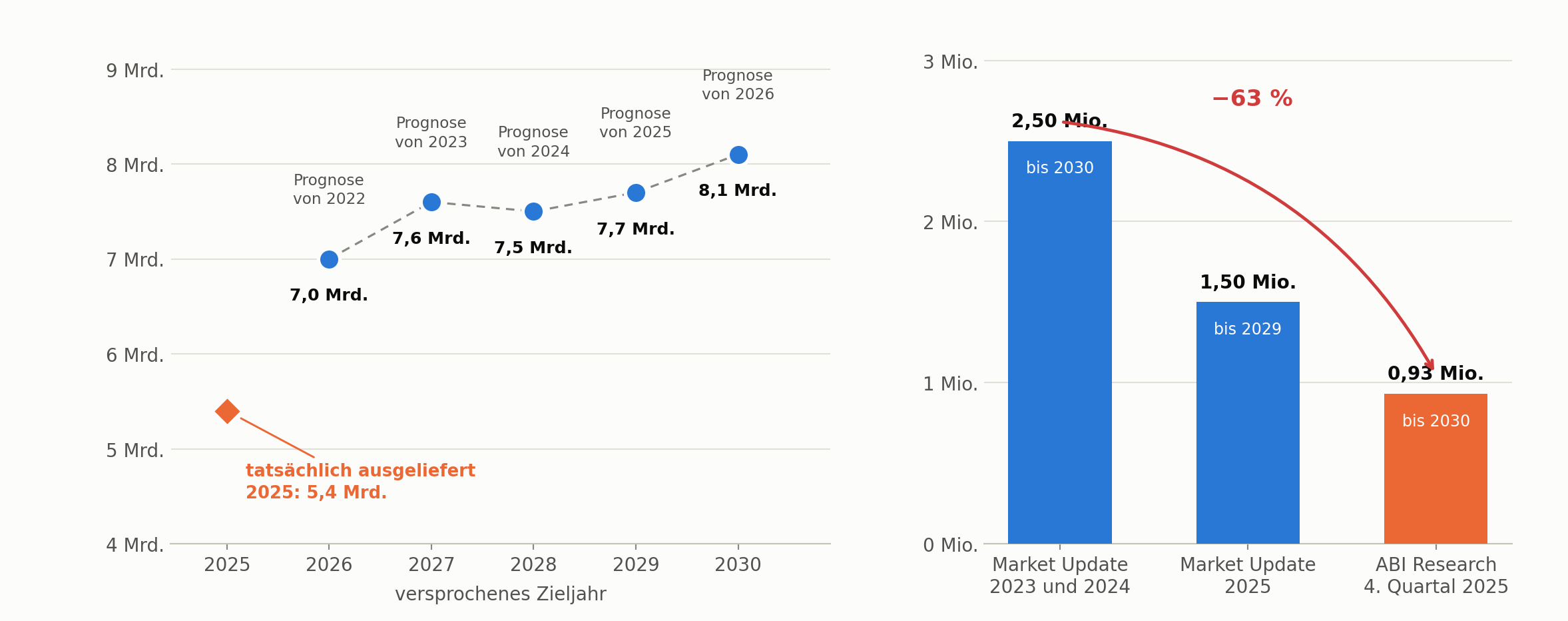
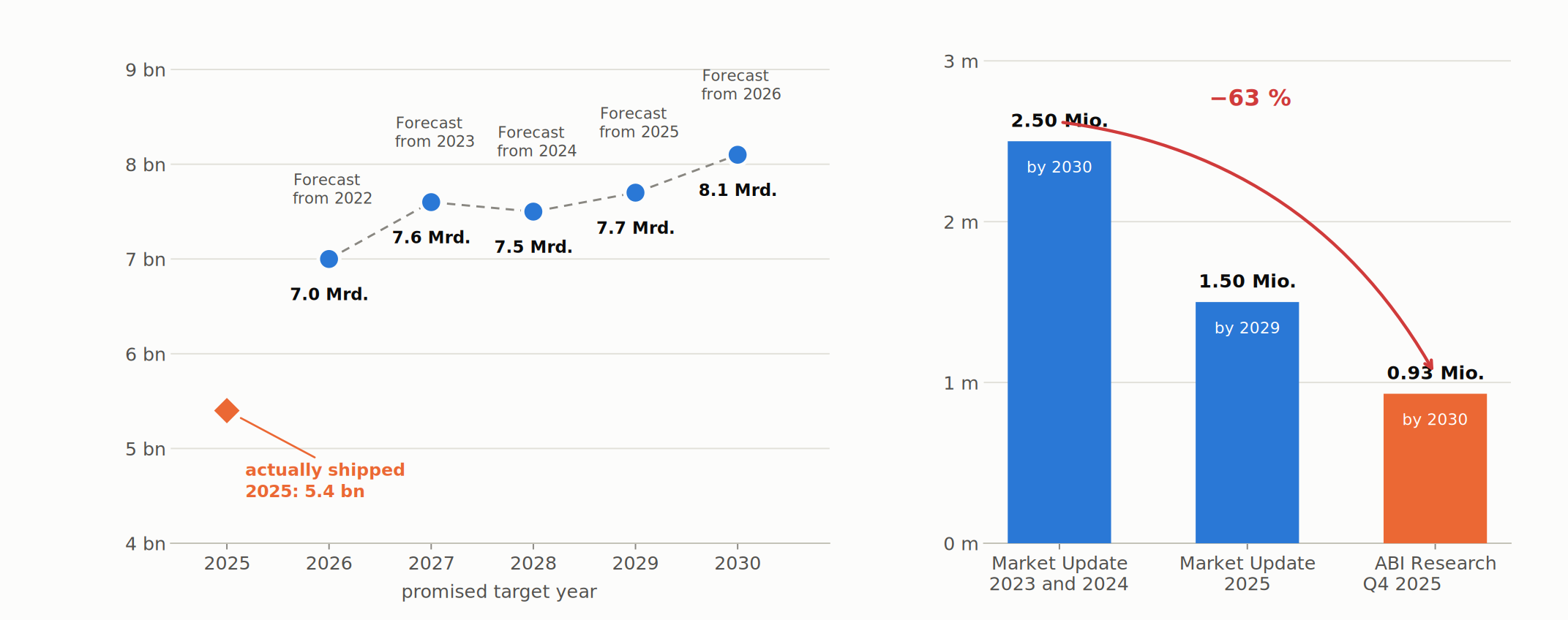
The horizon keeps moving. Every edition of the Bluetooth Market Update has named roughly the same figure for four years, each time for a target year one year later. That is a pointer about which sources to trust, not a verdict on the technology.
Bluetooth SIG Market Update 2022 to 2025 (data from ABI Research in each case), ABI Research Bluetooth Market Tracker and the SIG market dashboard, as of 1 July 2026.
Almost every Auracast figure in circulation comes from the same place. The Bluetooth SIG licenses market data from ABI Research and publishes it. “The SIG says X” and “ABI says X” are therefore the same statement.
Those figures have a pattern worth knowing about. The forecast horizon is five years in every edition, and the promised target stays at seven to eight billion devices a year. It travels along with the target year. The seven billion promised in 2022 for 2026 will not in fact be reached this year.
Two further clarifications usually get lost in the reporting. The figures are annual shipments, not the installed base. And they are LE Audio devices, not Auracast devices. Not every LE Audio device does Auracast, and certainly not as a transmitter.
None of that is a reason for scepticism about the technology. It is a pointer about which sources to trust. What is solid is what has shipped and been switched on. On that measure, 2026 looks considerably better than 2024.
What regulation does, and what it does not
It is worth contradicting a widespread assumption here.
The European Accessibility Act has applied since 28 June 2025 and is frequently cited as a driver for assistive listening. It covers products with a digital interface and certain services. It does not cover the built environment. Member states were given the option of extending it there and most did not take it up. What actually requires a transmission system for people with hearing loss, across most of Europe, is national building regulation. And the wording there is the interesting part. These rules typically ask for a suitable transmission system and name the induction loop as an example rather than as a requirement. Auracast is therefore, in principle, an admissible route.
What is missing is the conformity standard. Induction loops have IEC 60118-4, with a measurable criterion. For Auracast the equivalent, IEC 60118-17, is expected at the end of 2027. Until then, acceptance criteria should be agreed contractually rather than assumed. Two points for readers outside continental Europe. In the United Kingdom the duty runs through the reasonable adjustments provisions of equality law rather than through a product directive, and the same standards gap applies. In the United States the ADA additionally requires the operator to provide receivers, with headphones or neckloops. A transmitter on its own does not discharge the obligation there. That is a useful reminder everywhere else too, and it points in the same direction as the field evidence above.
This section is carefully researched but it is not legal advice. If you are deriving a tender from it, have it reviewed.
What is actually being built
The list of live installations has grown noticeably over the past eighteen months, and it is no longer confined to pilot projects.
- Frankfurt Airport, since 28 January 2026, gates A16 and A17 in Terminal 1, the world’s first airport with Auracast for public announcements, and Munich Airport, since 14 July 2026, with six gates across two terminals.
- In the United Kingdom, the cinema chain Vue with Auracast across eighteen sites as of July 2026, eight Delfont Mackintosh theatres in London from April 2026, and the Traverse Theatre in Edinburgh from June 2026, together with the candid assessment quoted earlier.
- Sydney Opera House, which added Auracast to its accessibility provision in 2025.
- Camera Zwo in Saarbrücken, since June 2026, the first German cinema with Auracast in all five screens, with screen selection through the hearing aid app, plus 90 new suburban trains in Munich, 84 classrooms in Munich schools and lecture theatres at KIT.
- The EUHA congress 2025 in Nuremberg, 9,000 attendees, two parallel language channels across three areas.
The candid finding from that congress is instructive. The lecture hall with professional sound pickup worked well, the audio was loud and clear over the background murmur. The open area next to it failed, though not because of the radio link. It failed because the microphone picked up too much ambient noise.
That is the single most important operating lesson. Auracast transmits exactly what arrives at its input. Sound pickup remains the real quality risk, not the radio path. What that means in practice we described in When the hall broadcasts.
What follows from all this
For procurement. Do not ask about the Bluetooth version. Ask whether the specific model has Auracast in the menu and from which firmware. The third of the three levels decides it, not the first.
For operators. Auracast is a viable solution today and in many venues the more economical one. The induction loop stays relevant alongside it for as long as it exists and works. Running both is not a compromise, during the transition it is the better provision. Two points are not negotiable. Always transmit a standard quality stream, because hearing aids and cochlear implants receive that one and no other. And keep loan receivers on hand, because your own devices are the only ones you know will work.
For anyone watching the market. Three things will decide the next two years: the smartphone platform that is still missing, the release at the two remaining hearing aid groups, and the test standard at the end of 2027. If one of them moves, the whole market moves with it.
Conclusion
The technology works, the hardware has been fitted for years, earbuds cost under fifty euros and the first airports are running it in normal service. What is missing is no longer an invention, it is a set of releases. Those are decided by a manageable number of companies, and across 2025 and 2026 most of them have delivered.
For a venue the practical consequence is pleasingly unspectacular. You do not have to wait until the market is finished. You need a transmitter on the existing sound system and a handful of loan receivers. That reaches everyone who comes today, and tomorrow it additionally reaches everyone whose own device has caught up.
How the devices work together is covered in Is Auracast Bluetooth? and in Does my smartphone need to support Auracast?. Our TX transmitter and RX receiver are on the product pages.
Try Auracast in your venue
We bring a transmitter and loan receivers and show you, in live operation, what already works today. Request a demo
Sources
Chips, platforms, operating systems
- Qualcomm: Snapdragon 8 Gen 1 Product Brief (30 November 2021)
- Google: LE Audio Auracast support expands to more Android devices (3 September 2025)
- Android: Compatibility Definition Document and Bluetooth LE Audio Overview
- Samsung: Using Auracast (as of 26 May 2026)
- Android Authority: Samsung Auracast in One UI 6.1 (20 February 2024) and Pixel support (3 September 2025)
- 9to5Google: Auracast on Pixel, 8a and 9a without the hardware; Android Police: Pixel Buds Pro 2 (2 October 2024)
- Microsoft: Shared Audio preview (31 October 2025)
- Apple: AirPods Pro 3 tech specs; Aurahear: WWDC 2026 without Auracast
Hearing aids
- Aurahear: Which hearing aids have Auracast built in (as of 14 July 2026)
- HearingTracker: Best Bluetooth Hearing Aids of 2026
- EFHOH: Emerging International Standards for Assistive Listening Systems (March 2026), timetable for the test standard
Devices, market and forecasts
- Bluetooth SIG: Auracast Product Finder and Market Dashboard
- ABI Research: Total Bluetooth Auracast Deployments by Venue Type
- IDC: Smartphone Market Share (data as of 23 June 2026)
- Counterpoint Research: Smartphone Replacement Cycle (18 November 2025)
- SoundGuys: What is Auracast (16 December 2025), reader survey
- audioXpress: Managing Expectations, The Bluetooth LE Audio Calendar (8 August 2024)
- FlatpanelsHD: LG OLED TVs add Bluetooth Auracast (22 July 2025) and Samsung is first to bring Auracast to TVs (30 August 2023)
Installations and regulation
- Fraport: Auracast at Frankfurt Airport (28 January 2026)
- Aurahear: Munich Airport latest to join the Auracast revolution (July 2026), UK cinema chain Vue installs Auracast in 18 venues (24 July 2026), Auracast comes to eight London theatres (10 April 2026), Auracast comes to Edinburgh’s Traverse Theatre (June 2026) and EUHA 2025; - GN: Sydney Opera House (March 2025)
- Deutscher Schwerhörigenbund: first German cinema with Auracast in every screen (4 June 2026)
- EUR-Lex: Directive (EU) 2019/882, the European Accessibility Act, recital 49 on the built environment; - ETSI: EN 301 549 V3.2.1, the European accessibility standard referenced by the Act
- IEC: IEC 60118-4, the conformity standard for induction loops
- Center for Hearing Access: ADA standards for assistive listening