
Auracast transmits in the 2.4 GHz band. So does your Wi-Fi. The two work side by side, but not on their own. This article explains why, which two fault patterns exist, and what a venue can actually do about them.
The short answer
If you take away three sentences, take these.
The most effective lever sits in the Wi-Fi, not in the Auracast transmitter. More transmit power buys you almost nothing, clean channel planning buys you a great deal.
There are two different fault patterns and they get confused regularly. “The broadcast does not appear in the list” has a different cause from “the audio stutters”. Treat one while the other is happening and you will search for a long time.
And both are foreseeable. The measures that work cost no money at all. Somebody just has to decide on them.
Everything that follows is the reasoning. If you want the measurements and the standards behind it, they are in the text and in the sources at the end.
Why the band is crowded
The 2.4 GHz band is a public square. Wi-Fi works there, so do cordless phones, wireless mice, building services, a great many sensors and, incidentally, the microwave in the staff kitchen.
Bluetooth and Wi-Fi share that square very differently. Bluetooth divides the band into forty narrow channels and hops between them constantly. Wi-Fi occupies wide blocks and stays put. A single Wi-Fi channel is as wide as ten Bluetooth channels.
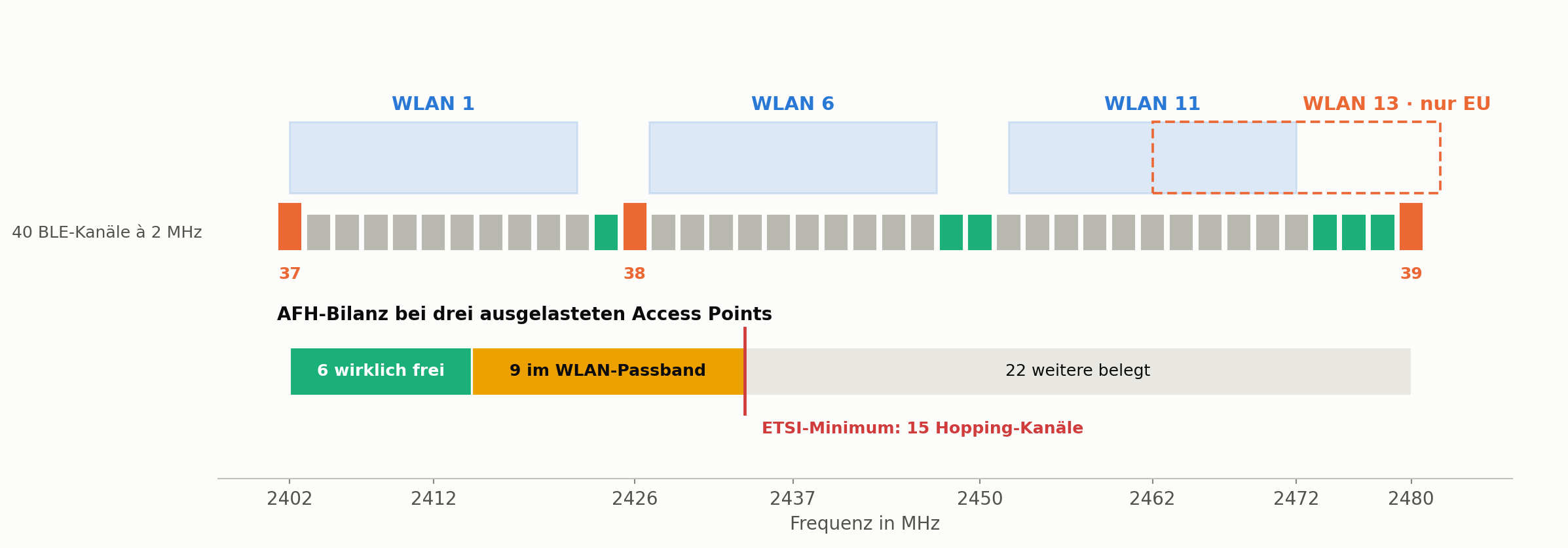
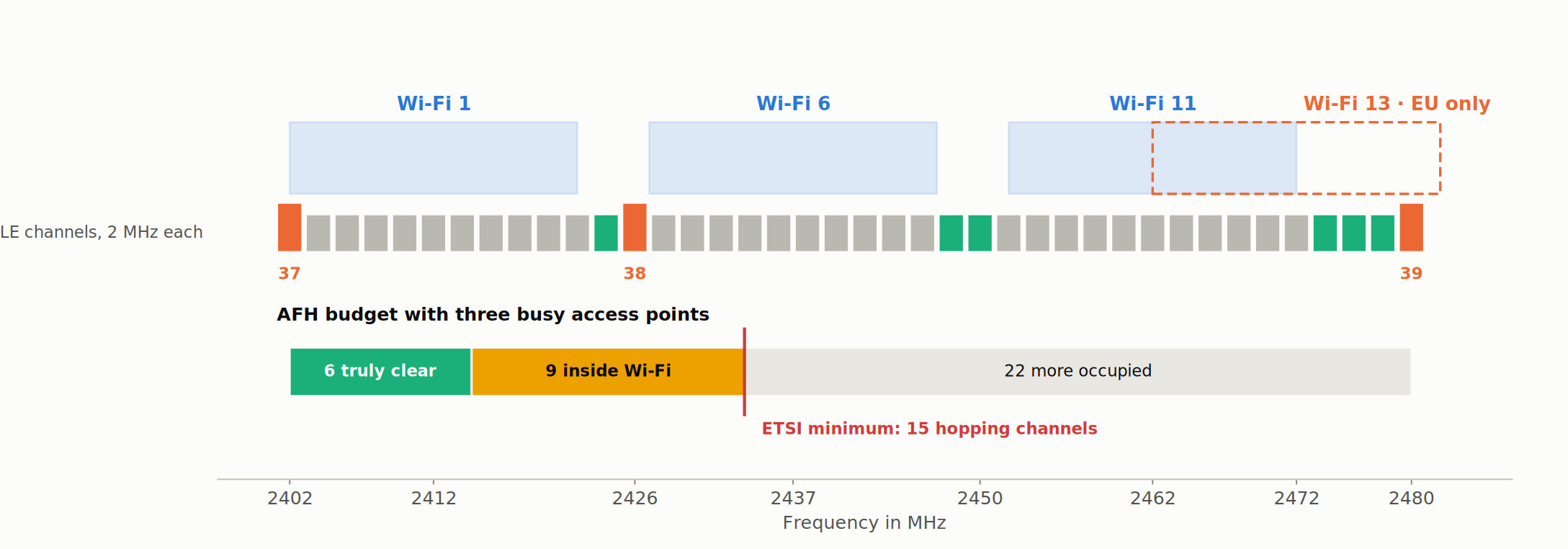
The 2.4 GHz band under full load. The three usual Wi-Fi channels above the Bluetooth grid, and the balance below. Six channels stay truly clear, while the European radio standard requires at least fifteen hopping channels.
Own illustration based on ETSI EN 300 328 V2.2.2 and the Bluetooth channel allocation; occupancy confirmed by measurement at Idaho National Laboratory, INL/RPT-23-74719.
Wi-Fi in this band normally uses channels 1, 6 and 11, because those three do not overlap each other. Lay them over the Bluetooth grid and 31 of the 37 audio channels sit underneath one of them. Six remain clear. Work with the transmit masks that are actually measured rather than the nominal figures and it is five.
That is the geometry of the problem in one sentence. Bluetooth does actively avoid busy channels, but there is very little left to avoid them into.
The point almost everyone misses
Besides the 37 audio channels there are three more. A transmitter uses them to announce that it exists. Those three channels are the only way a hearing aid or a phone finds a broadcast in the list at all. They do not hop. They are fixed.
One of them sits, in Europe, in the middle of Wi-Fi channel 13. That is exactly the channel access points like to move to, because at first glance it looks empty.
The consequence is awkward, because it does not look like a radio problem. The audio runs cleanly once you are connected. It is just that for some guests the broadcast never turns up in the list in the first place. Fault finding then usually goes to work on the audio, while the actual problem is discoverability.
Why an Auracast transmitter is blind
An ordinary Bluetooth connection is a conversation. Both ends acknowledge, both ends measure, and the receiving device can even tell the transmitter which channels are currently poor where it is sitting. The transmitter then avoids them.
An Auracast broadcast has none of that. There is no return path. The transmitter does not know who is listening, how many are listening, or what the radio environment looks like at their end. That very property is what makes Auracast scale so well: one transmitter, any number of receivers, no pairing. We covered it in more detail in Is Auracast Bluetooth?.
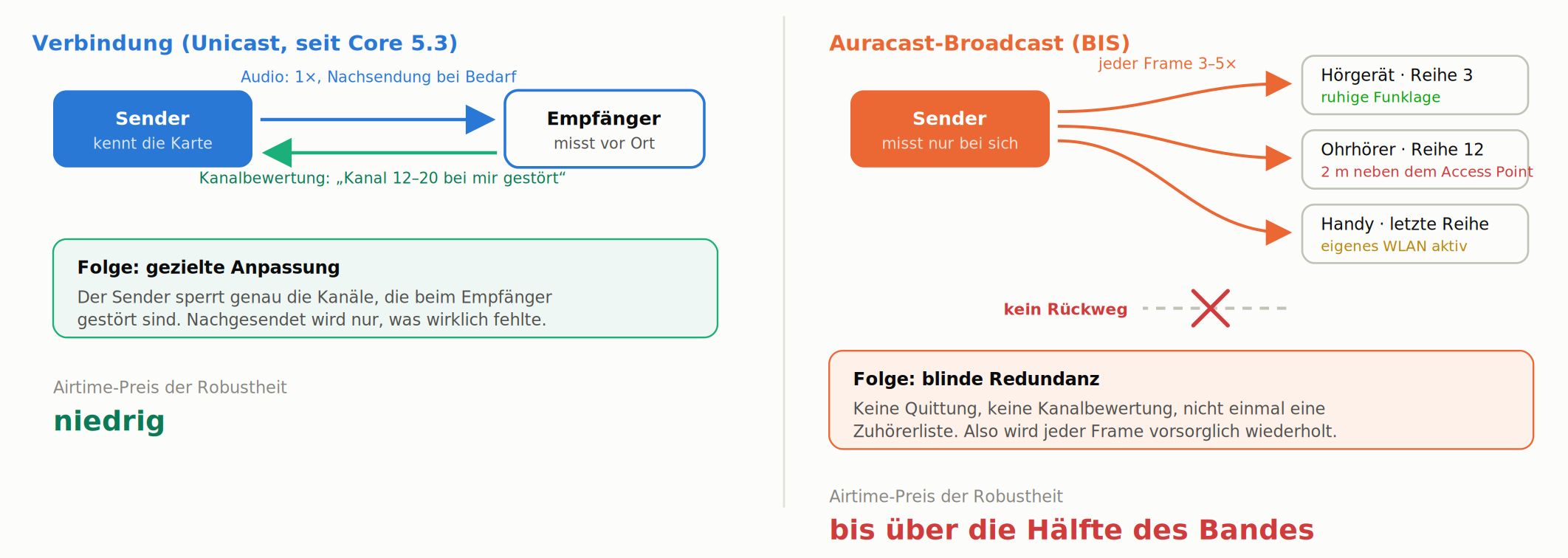
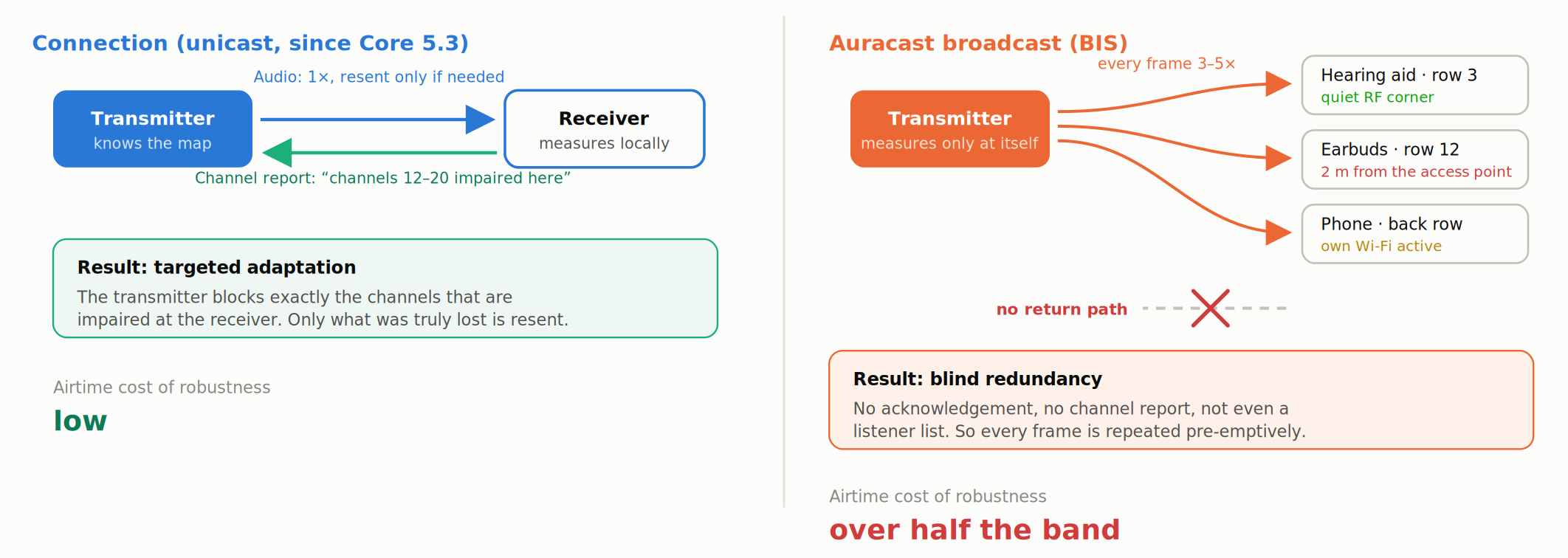
Feedback loop versus flying blind. A Bluetooth connection learns where the interference is and moves away from it. A broadcast learns nothing and repeats everything instead.
Own illustration based on Bluetooth Core 5.3 Feature Enhancements and the description of Broadcast Isochronous Streams.
The transmitter could of course measure for itself. It would simply be measuring in the wrong place. Whether a channel is usable is decided by the access point two metres from the hearing aid, not by the spectrum at the transmitter’s ceiling bracket. In a hall with six access points, every visitor sits in a different radio landscape.
The standard solves this the only way it can without feedback. If you cannot know which channel is bad, you send every audio frame several times and on different frequencies. Three to five transmissions per frame is the reference figure. It works remarkably well. It is paid for in airtime.
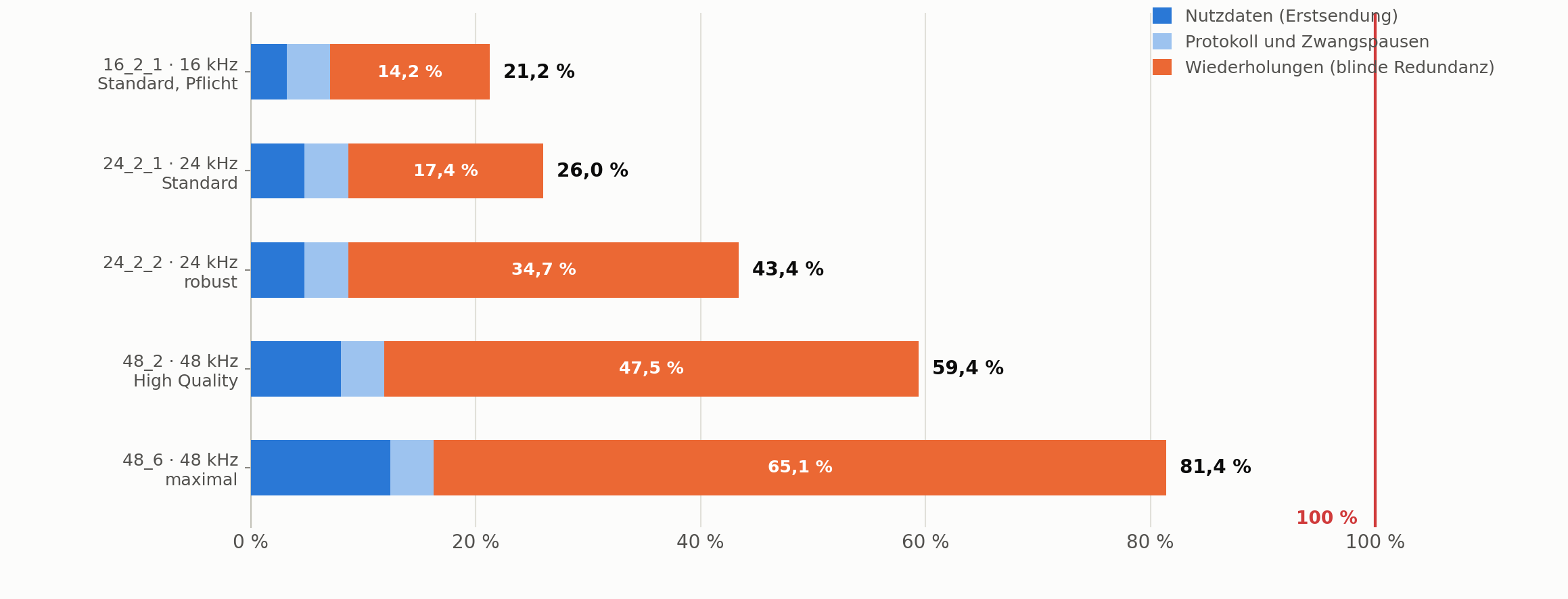
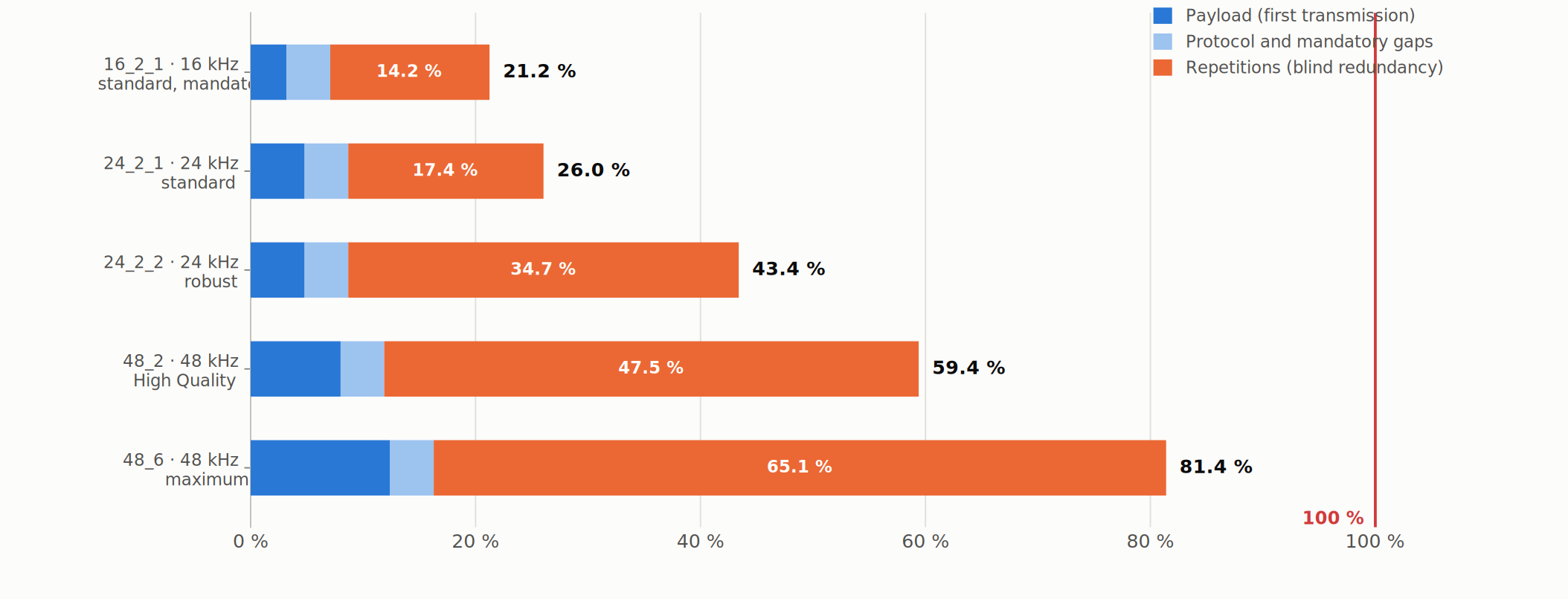
Where the airtime goes. Breakdown of the airtime a stereo broadcast occupies. The largest item is not the payload but the repetitions with which the transmitter compensates for the missing return path.
Own calculation from the packet structure, calibrated against the airtime tables in the Bluetooth SIG guide How to build an Auracast transmitter, May 2024.
For a stereo stream at high quality, the great majority of the occupied airtime goes on those repetitions. The payload itself, the part anyone actually hears, accounts for a small share. So if you want to run several streams in parallel, what stops you is not a shortage of channels but a shortage of time. The Bluetooth SIG works through its own example and arrives at a standard quality stream plus a high quality stream sitting close to the limit of what is feasible.
The practical lesson is a simple one. Streams are not free. Two well planned channels beat six that run “just in case”.
Why retreating is only partly allowed
Here a rule comes into play that few people have on their radar. The European radio standard for this band requires a frequency hopping system to use at least fifteen hopping channels. Use fewer and you fall under considerably stricter conditions, which in practice rule out a continuous audio transmission.
Clear channels, as counted above, number five or six. Fifteen are required.
So an Auracast transmitter in a fully occupied band has to use at least nine channels it knows carry Wi-Fi. The automatic avoidance that data sheets like to present as the solution is constrained by regulation precisely where you would need it most.
That is not a design flaw, it is a deliberate trade. A system that retreated into three clean channels would push everything else out of them.
Two measurement findings worth knowing
The research base on Auracast under interference is still thin. What is solid comes mainly from a Belgian research group and from a measurement campaign at the Idaho National Laboratory. Two findings from that work bear directly on planning.
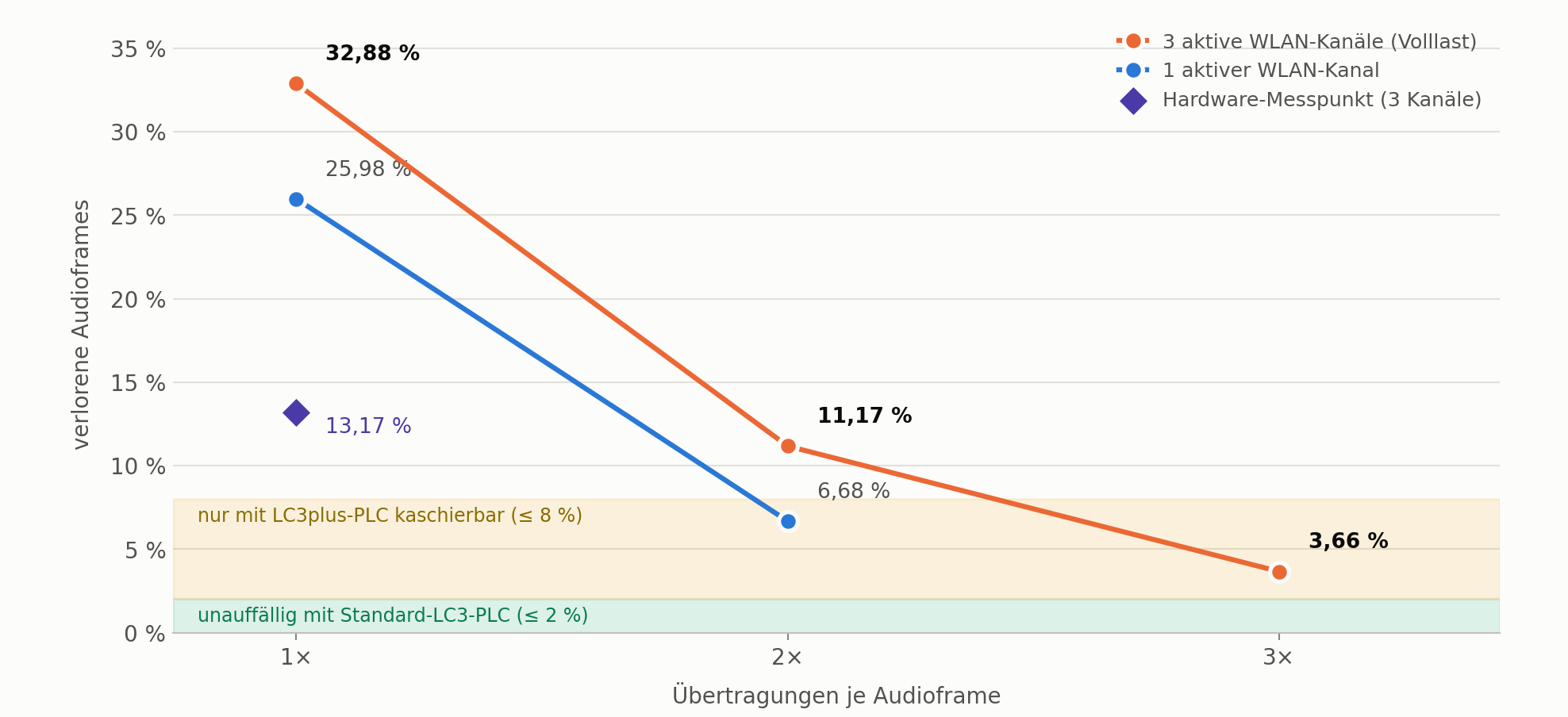
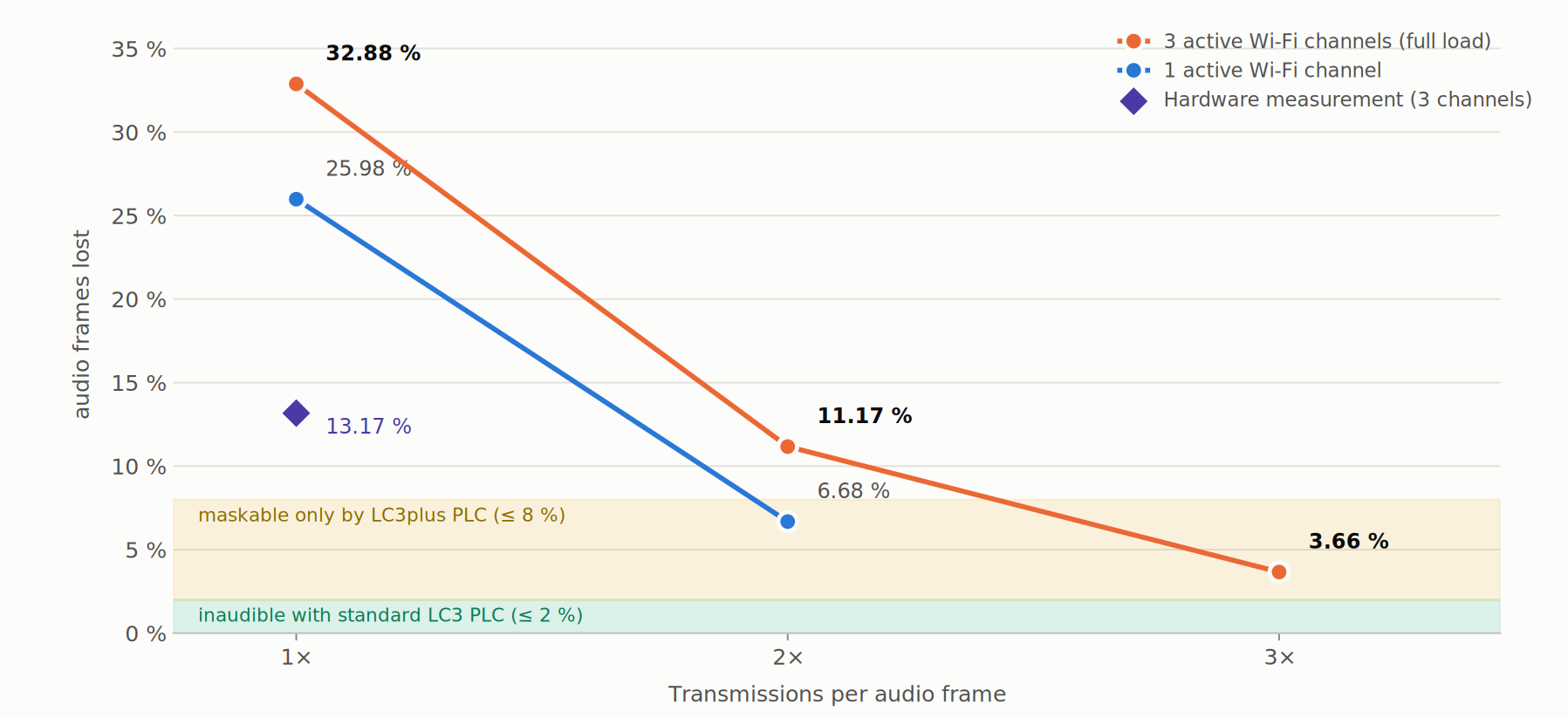
Repetitions buy reliability back. Share of audio frames lost against the number of transmissions per audio frame. Loss becomes audible at around two per cent, which is why four to five transmissions are the safe range.
Baert et al., Computer Communications 2024, and Baert et al., IEEE PIMRC 2024; audibility threshold from the LC3 Characterization White Paper of the Bluetooth SIG.
Repetitions work, but they need a run-up. With no repetition and Wi-Fi at full load, a substantial share of audio frames is lost. The second transmission pushes the loss down to roughly a tenth, the third to under four per cent. It becomes audible at about two per cent. So only the fourth or fifth transmission brings the stream safely below that threshold. That is exactly where the reference figures in the standard sit, which is a good sign. Somebody clearly did the arithmetic.
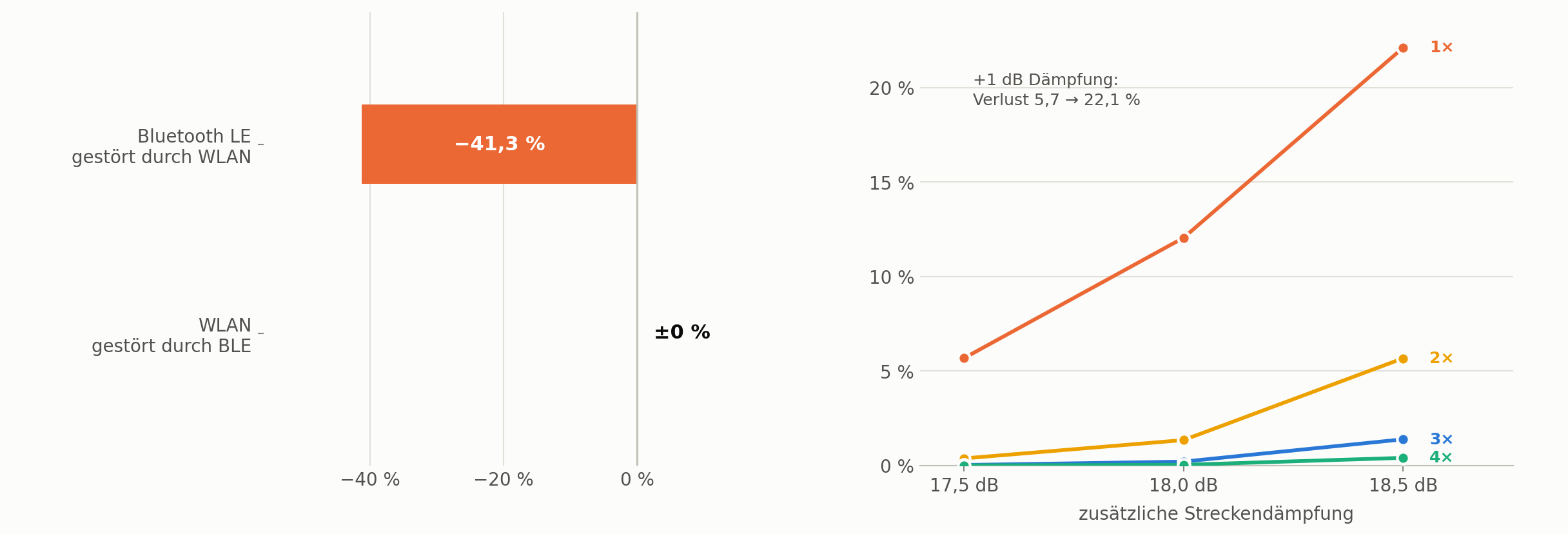
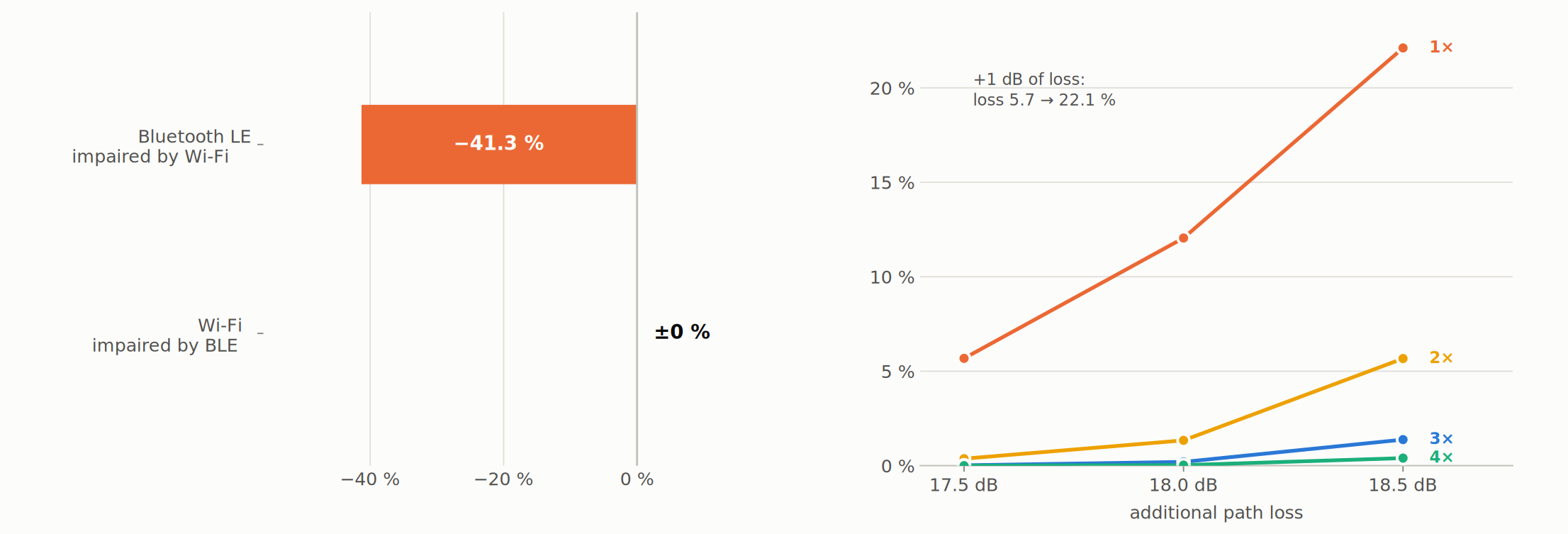
Two uncomfortable properties of the radio channel. Left: Wi-Fi listens before it transmits and Bluetooth may not, which is why the interference is one sided. Right: at the edge of range the link tips over instead of degrading gradually.
Idaho National Laboratory, INL/RPT-23-74719 (asymmetry and load dependence); Baert et al., IEEE PIMRC 2024 (measurement of the reception threshold).
The interference is one sided, and range has an edge. In the co-channel case Bluetooth loses a great deal of throughput while the Wi-Fi beside it carries on essentially untouched. The reason lies in regulation: Wi-Fi has to listen before it transmits, a frequency hopping system does not. Which is also why turning the Auracast transmitter up does not help. The disruption tracks how heavily the Wi-Fi is loaded, not how much power it radiates.
The second half of the same measurement matters even more for coverage planning. At the edge of the reception area Bluetooth does not degrade gradually. It tips over. In the hardware measurement a single decibel of additional path loss was enough to drive frame loss from twelve to twenty two per cent.
In practice that means range is not a soft quantity with Auracast. Plan with overlap, not with limit values. This lines up with what we described in Silent Events, Silent Conferences and Tours: the question is not how far a single transmitter reaches, but how many broadcast cells an area needs.
And what is missing from the research base? The most important part. To date there is no published study that measures Auracast against real, controlled Wi-Fi traffic. The simulations model Wi-Fi statistically, the hardware work reproduces only the frequency overlap. No measurement data from the known pilot installations is public either. Anyone planning today is planning with models, rules of thumb and physics. That carries further than you might think, but it is worth knowing what you are standing on.
What a venue can actually do
The list below is ordered by effect. The first three items sit in the network and cost nothing.
In the Wi-Fi
- Reduce occupied airtime in the 2.4 GHz band. Many enterprise networks already do this and switch off a proportion of their 2.4 GHz radios automatically, because little productive traffic runs there any more. The benefit for Auracast comes along for free.
- Switch off 40 MHz channels in the 2.4 GHz band. A single access point in that mode covers two of the three channels over which broadcasts are found.
- Avoid channel 13 in Europe. It sits on the advertising channel and produces the discoverability fault, the one that is hardest to diagnose.
On the Auracast side
- Approach transmit power from below. In the EU only ten milliwatts are permitted in any case. Experience from North America does not transfer, since ten times that is allowed there. As a planning figure, a radius of roughly thirty to forty metres per broadcast cell has proved sound, with about twenty per cent overlap.
- Use channel restrictions where the transmitter offers them. Some transmitters can be configured to leave particular channels out. The division of roles is worth noting: the audio system gets out of the network’s way. There is no agreed recommendation in the other direction, and to this day nobody publishes a minimum spacing between transmitter and access point.
- Be sparing with transmitter density. More transmitters improve coverage and worsen discovery time, because their announcement packets talk over each other. A study at the Air Force Institute of Technology found an optimum spacing of around fourteen metres with two or three transmitters, and only about nine with four to six.
- Standard quality is mandatory, not the budget option. Hearing aids and cochlear implants receive the standard quality stream and nothing else. A transmitter that only broadcasts high quality is invisible to precisely the audience the system was built for, and it occupies twice the airtime doing it.
At handover
- Test under real operating load. A site survey in an empty building with a quiet Wi-Fi measures a different building. Every system should be running as it does in normal operation.
One note for venues with a confidentiality requirement. The hopping sequence of a broadcast sits in the clear in the announcement data, even for encrypted streams. And a short broadcast code can be guessed. For public announcements neither matters. For a board meeting they do.
Will this get better?
Partly, and more slowly than one would like.
The move of Wi-Fi into the 6 GHz band helps. Every laptop that shifts across frees airtime in the 2.4 GHz band. Structurally, though, the band does not empty out. Bluetooth cannot migrate, and the base load from sensors and building services keeps growing. So the bottleneck changes shape. “Wi-Fi is eating the band” becomes “many narrowband systems with no coordination”. No new band fixes that, only coordination does.
The largest technical lever sits in the standard itself. Between two packets there is a fixed gap, left over from a time when radio chips needed switching time. In the mandatory configuration it accounts for over forty per cent of the occupied airtime. Bluetooth Core 6.0 introduces a mechanism to negotiate that gap. Whether broadcasts are allowed to use it is not documented unambiguously in public. It is the right question to put to your next chip supplier.
Conclusion
Auracast traded adaptivity for scalability. Any number of listeners, no pairing, no return path. The price is a transmitter that cannot see where things are going wrong in the audience, and pays for that blindness in repetitions.
In a radio quiet hall nobody notices. In a large, well covered building it is not a footnote, it is the basis for planning.
The good news is that the tools that work have been available for a long time and cost almost nothing. They simply sit on two desks that rarely talk to each other, the network team’s and the AV team’s. From the reporting on Frankfurt Airport comes the fitting line: the coexistence questions were resolved “through configuration optimisations”. So it can be done. It did not happen by itself.
What that planning looks like in daily operation, and the part loan receivers play in it, we described in When the hall broadcasts. How our TX transmitter and RX receiver fit into an existing audio infrastructure is on the product pages.
Try Auracast in your venue
We bring a transmitter and loan receivers, measure under your real network load, and tell you honestly what your building will support. Request a demo
Sources
Standards and specification
- Bluetooth SIG: How to build an Auracast transmitter (May 2024), airtime tables and worked example
- Bluetooth SIG: Auracast simple transmitter best practices guide
- Bluetooth SIG: Core 5.3 Feature Enhancements, channel quality reporting on connections
- Bluetooth SIG: Core 6.0 Feature Overview, Frame Space Update
- Bluetooth SIG: LC3 Characterization White Paper
- ETSI: EN 300 328 V2.2.2, minimum number of hopping frequencies in clause 4.3.1.4.3.2
Measurements
- Silicon Labs: UG103.17 Wi-Fi Coexistence Fundamentals
- Idaho National Laboratory: INL/RPT-23-74719, Experimental Evaluation of Interference in 2.4 GHz
- Baert et al.: Evaluation of BLE-based audio broadcasting under probabilistic interference, Computer Communications 2024
- Baert, Pittevils, Moons, Hoebeke: Experimental validation of a Bluetooth-based speech audio broadcasting model, IEEE PIMRC 2024
- Puseman: Optimization of Bluetooth Auracast Broadcast Audio Transmissions, AFIT 2024, transmitter spacing
- Apel: Bluetooth LE Audio in the Real World, audioXpress 2026
Practice and security
- Fraport: press release on Auracast operation (28 January 2026)
- connect professional: Auracast pilot at Frankfurt Airport
- Cisco: Flexible Radio Assignment and Juniper Mist: RRM and auto cancellation
- Heinze, Steinmetz: Bluetooth Auracast from a Security Researcher’s Perspective