
Is Auracast Bluetooth?
Short answer: Yes. Auracast is Bluetooth, but not quite the Bluetooth that most of us know from everyday life. Anyone who has ever "paired" headphones with a smartphone knows one side of Bluetooth. Auracast belongs to a newer, second side of the same technology. This very difference is what makes Auracast so exciting for accessible listening in churches, halls, and public buildings.
In this article, we explain how Auracast and Bluetooth are related, what the difference is from classic Bluetooth, and what that means in practice.
Auracast is part of the Bluetooth standard
Auracast was developed by the Bluetooth Special Interest Group (SIG) – that is, by the very organisation that also manages the rest of the Bluetooth standard. Therefore, Auracast is not a competing product or a proprietary development of a single manufacturer, but an official part of Bluetooth.
More specifically, Auracast belongs to Bluetooth LE Audio, the next generation of Bluetooth audio transmission. "LE" stands for Low Energy, which is the energy-saving variant of Bluetooth. LE Audio builds on the Bluetooth core standard from version 5.2 and introduces a new audio codec called LC3, which delivers good sound quality with lower energy consumption.
Auracast is the function within this LE Audio framework that enables the so-called Broadcast Audio which allows audio to be sent to many recipients simultaneously.
The crucial difference: Sending instead of pairing
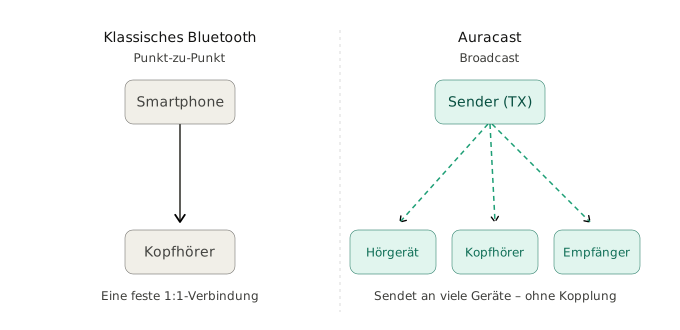
Classic Bluetooth operates on the principle of a private one-to-one connection. A transmitter is paired with a receiver: the smartphone with the headphones, the tablet with the speaker. If someone wants to let another person listen, they quickly run into limitations, as each additional device requires its own connection.
Auracast turns this principle on its head. Instead of connecting to a single device, a Auracast transmitter sends an audio stream openly into the room – similar to a small radio station. An unlimited number of devices can receive this stream simultaneously, without the need for a traditional pairing. The number of listeners is technically not limited.
A good analogy is Wi-Fi: Just as you select and join the appropriate network from a list in a café, you choose the desired audio stream from the available options in Auracast and simply listen in. Some providers further facilitate joining via a QR code.
How to join an Auracast transmission
In the Auracast world, there are three roles that describe the interaction:
- The transmitter (Transmitter): a device that sends out an audio stream – such as a television, a sound system, or a special Auracast transmitter.
- The receiver (Receiver): the device that plays the sound – for example, headphones, in-ear headphones, a hearing aid or a cochlear implant.
- The Assistant (Assistant): a device like a smartphone or a smartwatch that helps in selecting the appropriate stream.
This division has a practical advantage: The actual hearing aids or headphones remain simple and energy-efficient, while the smartphone takes care of the selection. The sound itself then goes directly to the hearing aids.
What makes Auracast technically different
Because Auracast is based on Bluetooth LE Audio, it brings some features that classic Bluetooth in this form does not offer:
- One source, any number of receivers. A single stream supplies an entire hall, instead of establishing a separate connection for each device.
- No pairing required. Joining works like selecting a Wi-Fi network, not like the tedious pairing of two devices.
- Low latency. Image and sound remain in sync, which is important for lectures, films or live events and also for lip reading.
- Low power consumption. Especially for hearing aids and small receivers that run all day, this is crucial.
- Encryption possible. Streams can be open or password-protected – depending on whether it is about public announcements or private content.
Which devices support Auracast?
Auracast requires devices that support Bluetooth LE Audio – this is not automatically the case with every older Bluetooth device. On the smartphone side, support has significantly increased in recent years, particularly with newer models from Samsung, Google Pixel, and Xiaomi. More and more hearing aids from leading manufacturers are also already incorporating Auracast, and the expectation in the industry is that it will become the standard in the coming years.
Those using older hearing aids or headphones without Auracast are not excluded: a compact Auracast receiver – optionally with an inductive neck loop – bridges the gap until their own hearing aid can receive Auracast directly.
Why this is so important for accessible hearing
It is precisely at this point that a technical detail becomes a real added value. Many people with hearing aids experience a sermon, a lecture, or a conversation at the counter as if they were sitting without a microphone in a reverberant room. The actual problem is rarely the volume, but the clarity – reverberation, distance, and difficult room acoustics make speech laborious.
Auracast transmits sound directly and clearly to the hearing aid or a personal receiver. Reverberation, distance, and background noise are largely eliminated. Unlike the previously common induction loop, Auracast can also be set up without extensive structural measures – a practical way to improve accessibility for churches, cultural venues, universities, and public buildings.
This is exactly where Summitwave comes in: We bring Auracast into professional environments so that speech reaches where it is needed – directly in the ear.
Conclusion
Is Auracast also Bluetooth? Yes, Auracast is an official part of the Bluetooth standard, specifically Bluetooth LE Audio. The difference from classic Bluetooth lies not in the brand, but in the principle: instead of permanently pairing two devices, Auracast transmits audio openly to any number of receivers simultaneously. From this small shift, from pairing to sending, a technology emerges that places shared listening and, above all, barrier-free understanding on a new, simple foundation.