
About accessible audio, hearing assistance and modern venues.
In the current INTHEGA Cultural Journal 2/2026 Summitwave was presented under the title “When the hall broadcasts” Shortly thereafter, we were able to discuss this very topic at the INTHEGA Theatre Market in Bielefeld with many venues, cultural offices and technical managers.
For us, this exchange was particularly valuable because it showed: The topic of hearing assistance has arrived in the industry, but the starting points are very different.
Some venues are still at the very beginning and have hardly any contact with technical hearing support. Others are familiar with classic induction systems but do not know exactly how well these work in their own venue or how they can be replaced or supplemented in the future. And some venues are already specifically dealing with Auracast or implementing initial solutions.
We experienced exactly this broad spectrum at the INTHEGA.
And it confirms our impression: Accessible audio is no longer a fringe topic. It is becoming an infrastructure issue for modern venues.
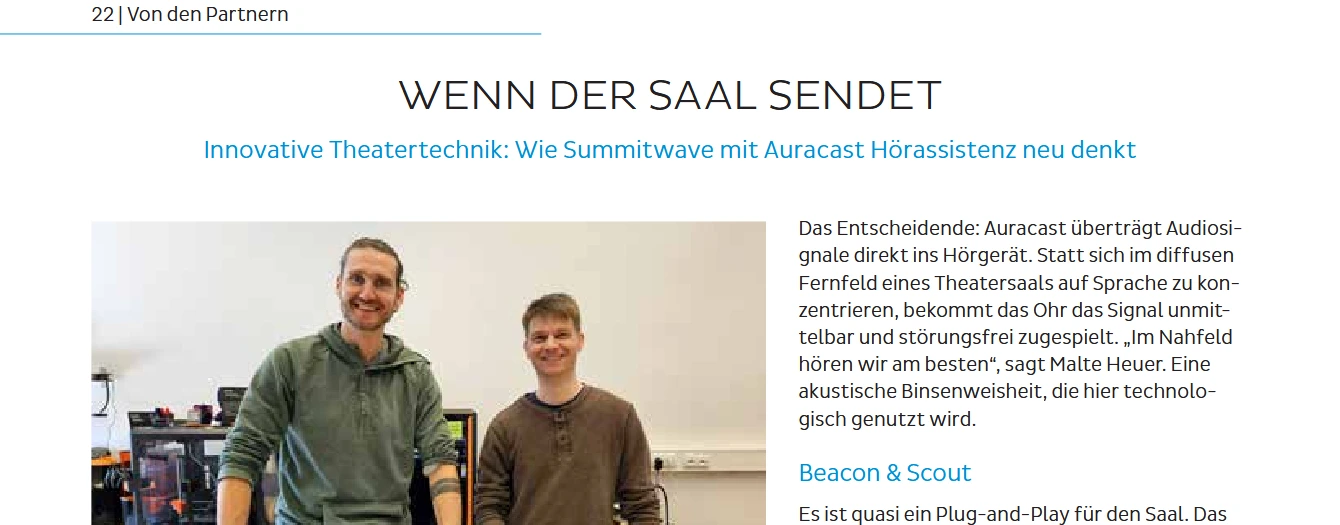
Summitwave in the INTHEGA Cultural Journal 2/26
Many venues, similar questions
At the INTHEGA, we mainly spoke with small and medium-sized event venues: town halls, cultural centres, theatres, municipal event locations, and multifunctional spaces.
These venues often have very practical questions:
What is the current state of technology?
Do we need to install an induction loop?
Does it work without major structural changes?
Can guests use their own hearing aids or headphones?
Do we still need loan devices?
How do we explain this to the audience?
What happens with guest performances that have changing technology?
Can we also offer translation or audio description with this?
It was noticeable: the question is rarely just technical. It is almost always about operation.
A solution must not only work on paper. It must work at the box office, at the cloakroom, in the technical room, and during the event. It must be explainable to the staff and remain understandable for guests.
This is exactly where it is decided whether accessibility really reaches everyday life.
Why 'louder' is not automatically clearer
In many conversations, it quickly became clear: if people in the hall struggle to understand, it is not just about the volume.
Language can be loud and still incomprehensible. Distance from the stage, reverberation, background noise, reflections, and difficult seating positions affect how clearly language is received. For people with hearing impairments, this quickly becomes a barrier.
A hearing aid can achieve a lot. But if the signal arrives at the ear already mixed with room reverberation and background noise, an amplified signal will not automatically be understandable.
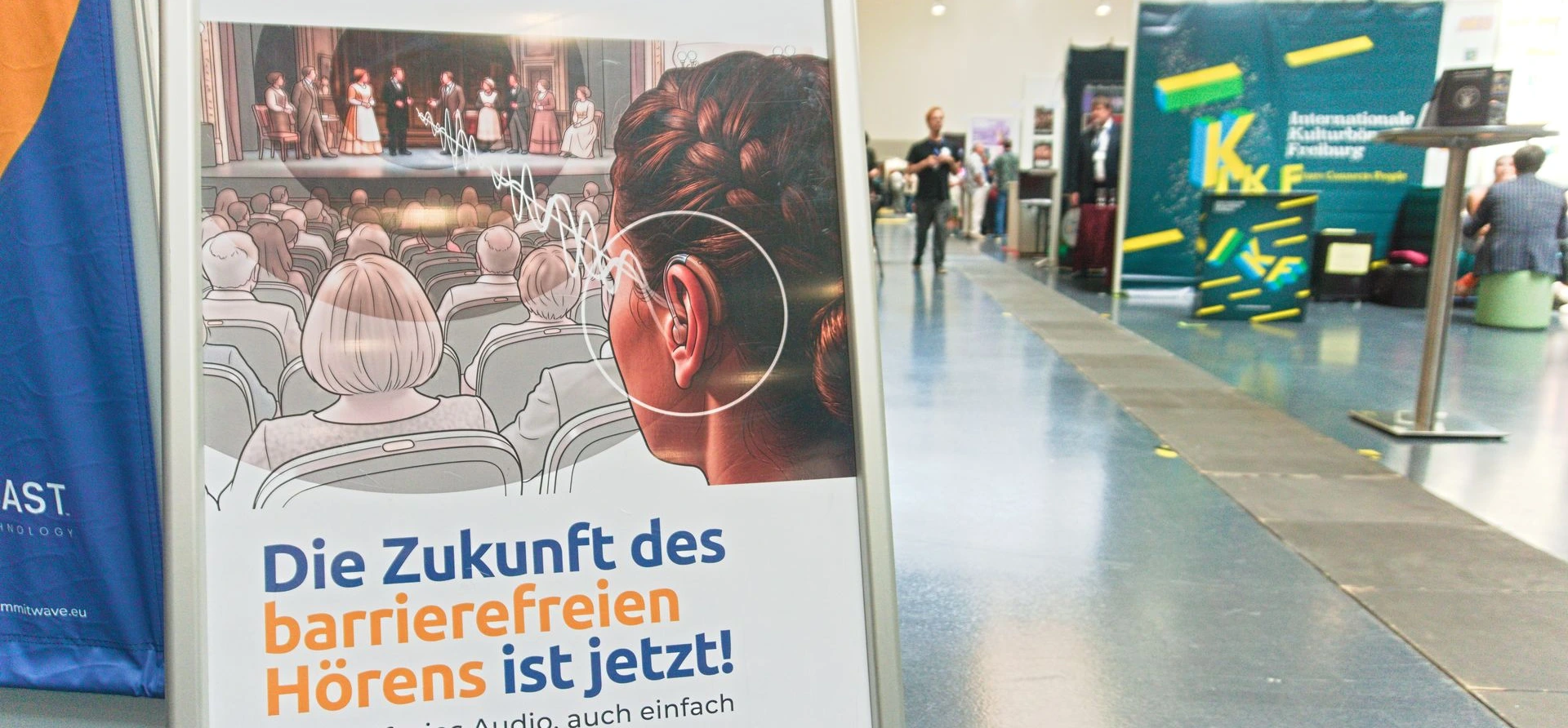
That is why modern hearing assistance needs a different approach:
Not just making it louder.
But bringing the signal closer to the listeners.
A clear audio signal makes the content accessible – just as a ramp makes the space accessible.
The hall as a transmitter
With Auracast, a new way to provide audio in event spaces is created. Simply put, Auracast works like a "Bluetooth radio" for rooms: A transmitter provides one or more audio streams, and many receivers can listen simultaneously.
This is an important difference from classic Bluetooth. There, a device is usually paired individually with another. For a public event space, this is impractical. No one wants to connect every hearing aid, every headphone, or every smartphone individually before a performance.
With the broadcast principle, the room transmits. Guests select the appropriate stream. The signal comes directly to them – for example, on compatible hearing aids, earbuds, headphones, or special receivers.
For venues, this means: The existing sound system remains in place. The artistic sound image in the hall is not replaced. But people who need a clearer signal receive an additional, direct access to the sound.
The hall does not just get louder.
It becomes more accessible.
TX and RX: Technology for real event operations
The Summitwave system consists of two central components:
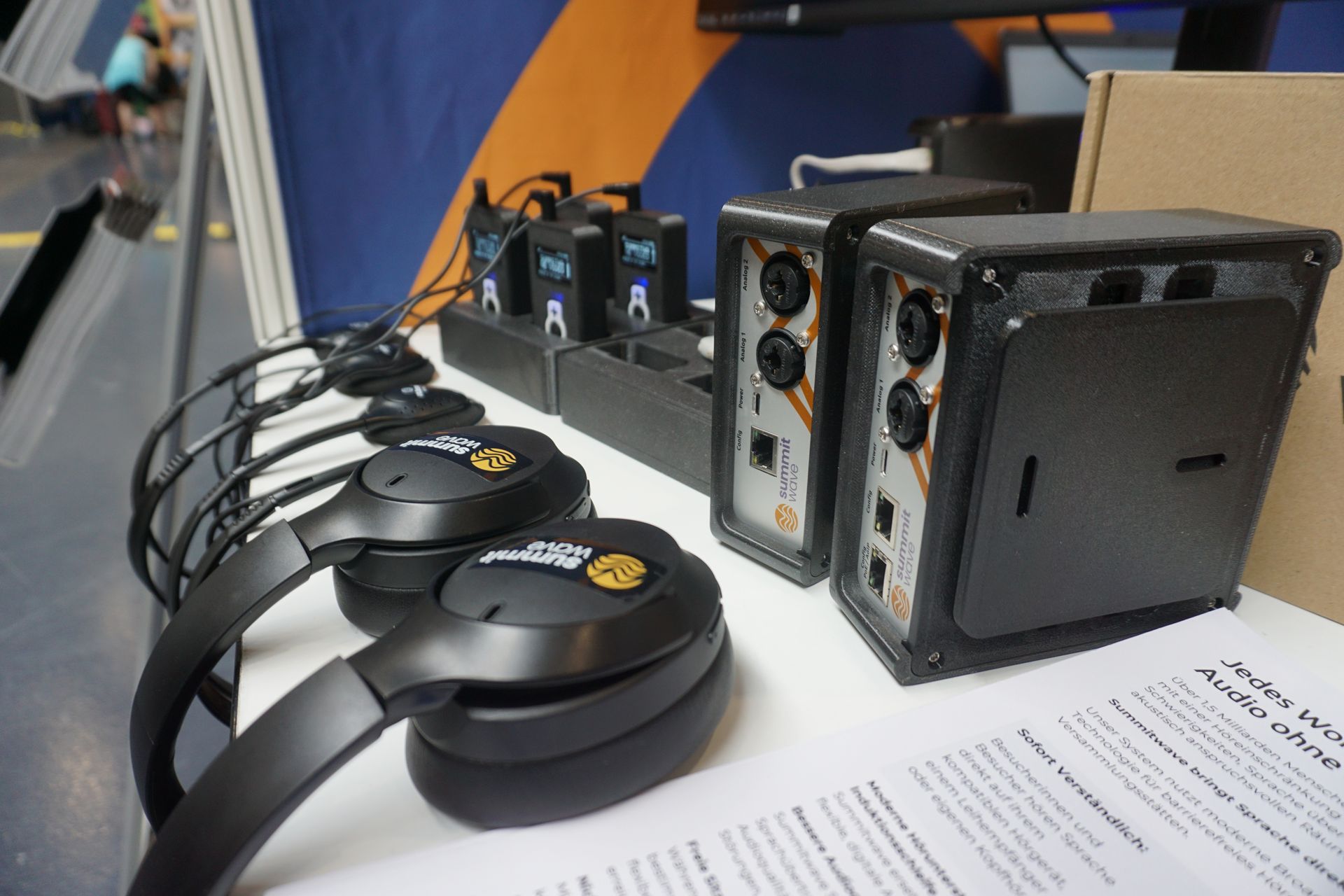
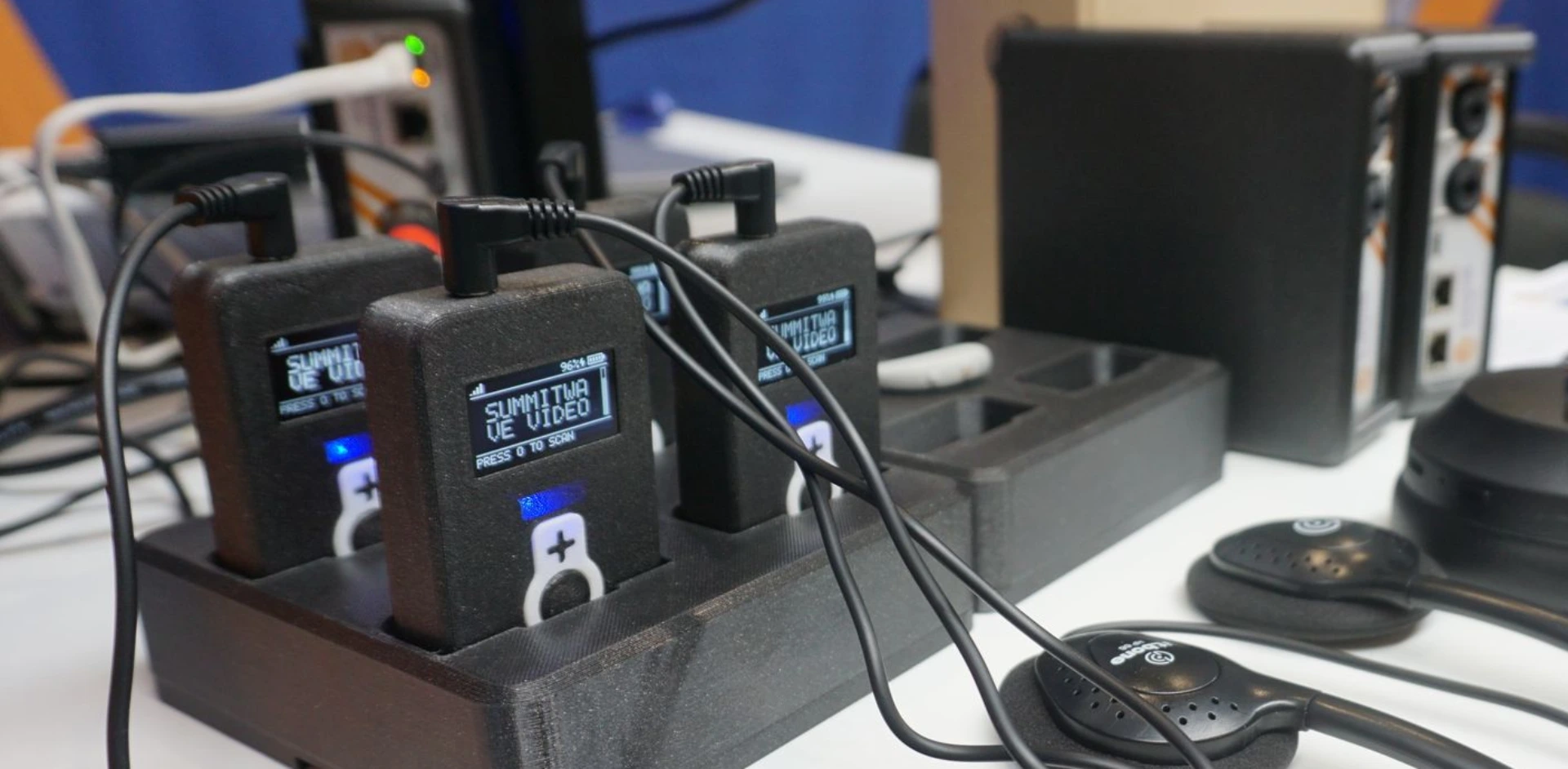
The TX is the transmitter. It is integrated into existing audio setups, for example in a PA system, a mixing console, a conference room, or a media technology installation. The goal is not to replace the existing technology, but to expand it with an additional signal path.
The RX is the receiver. It can be issued as a loan device if guests do not have their own compatible device or need a simple, reliable solution on site. An audio stream can be selected via the RX and used with headphones or suitable accessories.
This is particularly important because while Auracast is a future standard, not everyone will immediately have suitable devices. Accessibility must not depend on whether someone has the latest hearing aid or the newest earbuds.
That is why both are needed:
Openness to personal devices.
And a reliable loan solution for the venue.
One topic, many use cases
At INTHEGA, it became clear that hearing assistance is indeed the most important entry point, but it is not the only use case.
Hearing assistance
People with hearing impairments receive the speech or stage signal directly to a personal receiving device. This reduces the influence of room reverberation and background noise and can make speech significantly more intelligible.
Multilingualism
Multiple language channels can be transmitted in parallel. This is interesting for international guest performances, congresses, festivals, multilingual city events or tours.
Audio description
An additional channel with image description can be offered for blind and visually impaired visitors. The spatial sound remains unchanged for the rest of the audience, while the additional information reaches directly those who need it.
Language focus
A particularly language-optimised stream is also conceivable – for example, for lectures, panel discussions, readings or events where comprehensibility is more important than a musically mixed hall signal.
The crucial point is: These applications do not need to be thought of as four separate special solutions. They can be part of the same modern audio infrastructure.
[IMAGE 5 – TRADE FAIR CONVERSATION / BOOTH SCENE]
Motif: Conversation at the Summitwave booth, devices in the foreground, visitors in the background.
Alt text: Consultation at the Summitwave booth at the INTHEGA theatre market.
Caption: Many conversations at the INTHEGA revolved around the same question: How can hearing assistance be made truly practical in the everyday life of events?
What we take away from the INTHEGA
Our most important impression: The industry is very open to new solutions, but it needs guidance.
Many venues know that they need to deal with hearing assistance. At the same time, the market is confusing. Classic induction is known but not always understood. Auracast is exciting but still new for many. Some have no solution at all. Others are already remarkably advanced.
That is why small and medium-sized venues do not need an abstract vision of the future, but concrete answers:
What can be done with our existing technology?
How large is the installation effort?
How many receivers do we need?
How do we train our staff?
How do we inform our audience?
How do we test the whole thing without immediately renovating the entire venue?
We take these questions with us from Bielefeld.
And they reinforce our belief that Summitwave should not only be thought of as a product but as a system for everyday use: technically robust, easily explainable, and fitting into the processes of venues.
Pilot projects sought
Following the discussions at INTHEGA, we are specifically looking for further pilot projects with small and medium-sized venues that would like to practically test modern hearing infrastructure.
Particularly interesting are:
Town halls
Cultural centres
Theatres
Churches
Universities
Museums
Municipal event spaces
Multi-purpose halls
A pilot project does not have to encompass the entire house immediately. Often, a clearly defined start is sensible: a hall, a series of events, a lecture, a guest performance, a service, or a format with special needs.
This can be discovered in real operation:
How does the coverage in the room work?
How do visitors respond?
How many loan devices are actually needed?
Which explanation is understandable?
Which channels are sensible?
How can the system be integrated into existing processes?
Such projects create not only technology. They create experience.
Conclusion: Accessibility does not stop at the hall door.
Accessibility is often first thought of architecturally: ramps, lifts, wheelchair spaces, or guidance systems. All of this is important. But a person can sit in the room and still be excluded from the content.
If the language is not understandable, an event remains inaccessible.
A hall that broadcasts can change that. It brings audio not only generally into the room but makes it individually accessible – for hearing aids, headphones, loan receivers, multilingualism, and audio description.
INTHEGA has shown us how great the need for practical, understandable, and affordable solutions is. It has also shown how much openness exists in the industry.
For us, it is clear: modern hearing assistance is not solved by a single device. It arises from good technology, good integration, and good explanation.
This is exactly what we are working on with Summitwave.
Test Auracast in your home
Would you like to test accessible audio, multilingualism or audio description at your venue?
Contact us. We will assist you in integrating Summitwave TX and RX into your existing audio infrastructure – from the first test to a scalable concept.